In the late 1940s, physicists were working to improve the design of a vacuum tube used by the U.S. military in World War II to detect enemy planes by amplifying their signals. Charles Townes, a researcher at Bell Labs in Murray Hill, N.J., was one of them. He proposed creating a more powerful amplifier that passed a beam of electromagnetic waves through a cavity containing gas molecules. The beam would stimulate the atoms in the gas to release their energy exactly in step with the beam’s waves, creating energy that allowed it to exit the cavity as a much more powerful beam.
In 1954 Townes, then a physics professor at Columbia, created the device, which he called a “maser” (short for microwave amplification by stimulated emission of radiation). It would prove an important precursor to the laser.
Notes:
It’s difficult to imagine a world in which lasers were invented later, or not invented at all.
In both cases our technological baselines would be completely different, and the history of this tech (and its development) implies a sort of linearity to technology (one thing leading to another), even though that’s seldom the case (no matter what games like the Civilization series and its tech tree tells us).
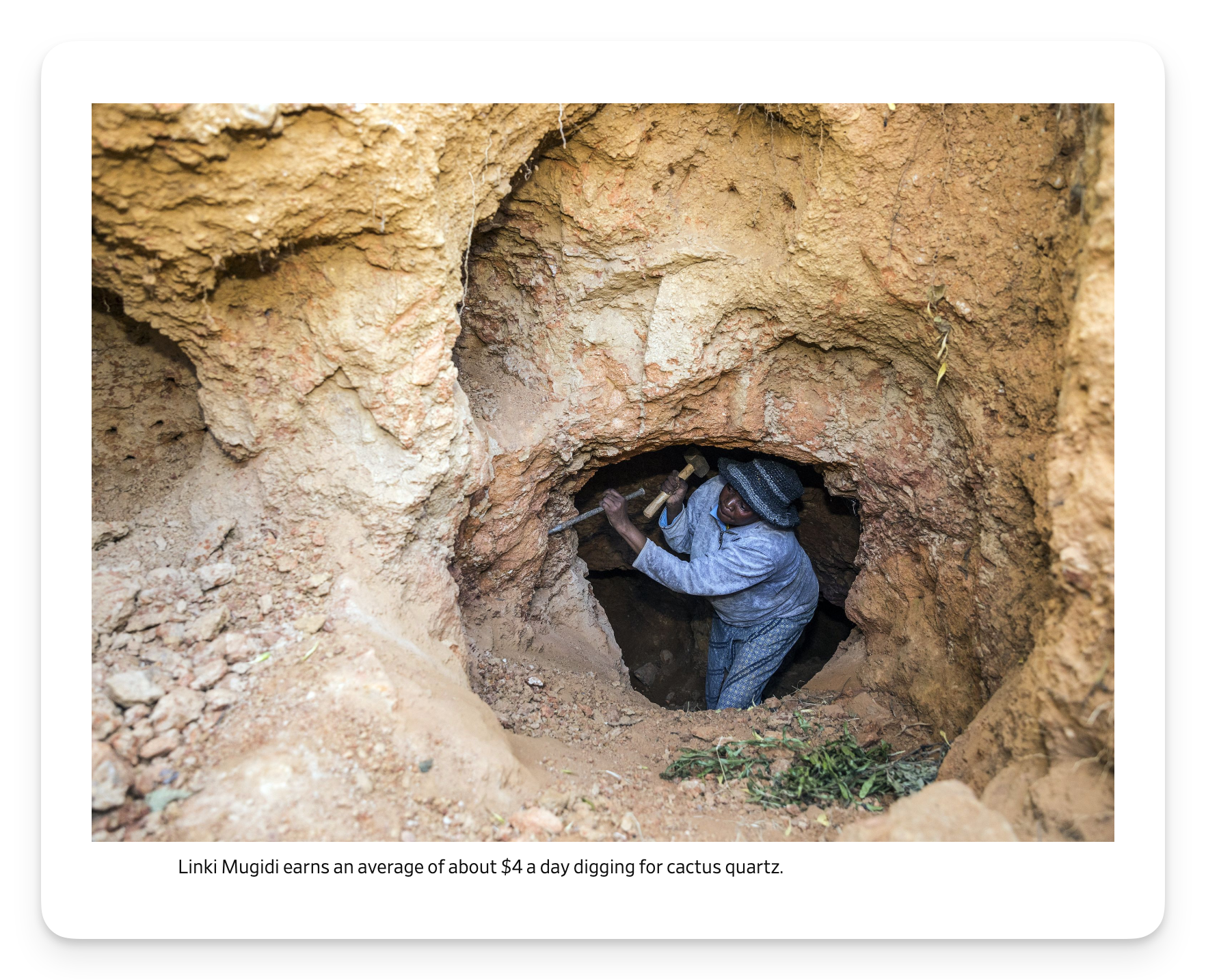
In recent years, endorsements from celebrities like Gwyneth Paltrow, Kim Kardashian and Adele have helped turn crystal quartz from a New Age fad into a growing slice of the booming wellness industry.
That has set off a rush to find quartz, one of the most common minerals on Earth, but one for which scientists say there is no evidence for healing or other powers.
“Right now the global crystal market is kind of like the Wild West,” says Cristina Villegas, director of sustainable markets at Pact, a Washington, D.C., nonprofit. “The serious risks can range from tunnel collapse, sudden flooding, free fall or asphyxia due to lack of ventilation.”
Crystal quartz is often sold via online crystal stores and collector websites alongside jewelry and trinkets. Polished, jewel-colored as well as colorless quartz can sell from a few dollars to tens of thousands of dollars, depending on the color and size of the crystal.
Notes:
A good reminder that the “wellness” and “new age” and “spiritual” industries are very much industries, with all the downsides and victims of any other (global, growing, celebrity-endorsed) industry.
In Phoenix, heat is a constant challenge: Last year, the city experienced 31 consecutive days of temperatures above 110F (43C). That’s why Phoenix’s Paideia Elementary started buying cooling vests loaded with ice packs for its teachers to wear during daily dismissal. The school now has more than 30 of them.
“School starts Aug. 1 when [it’s] over 100F, and that is going all the way through September,” says Brian Winsor, executive director of Paideia Academies, which also includes a 7th-to-12th-grade school.
Paideia Elementary’s ice vests are just one example of the adjustments made necessary by a warming world. This year is poised to be the hottest ever, leaving systems, services and infrastructure struggling to function. High temperatures have melted roads, strained power grids and killed thousands. They’re also forcing a rethink of the most quotidian activities, from choosing an outfit to buying groceries or simply falling asleep.
Notes:
This trend will be more immediate some places than others, but portions of the world—including some of the world’s most populous cities—are seeing regular, persistent heat waves that are barely survivable without some kind of augmentation, and not comfortable or pleasant with those supports, and this is leading to a lot of adjustments, many of which are early versions of what will likely arrive within the next few years as more people realize this isn’t a blip, but a new reality.
In the hours before Ukrainian soldiers stormed across Russia's western border, there was no sign from Moscow that anything was amiss.
At midnight at the start of Aug. 6, the Russian defence ministry posted good news: more than 2,500 members of the regiment responsible for the capture of a town in eastern Ukraine would receive state awards for heroism.
Later that morning, as Ukraine began the biggest invasion of Russia since World War Two, the ministry published video showing General Valery Gerasimov, commander of the Russian war effort, visiting a different combat zone, also in Ukraine. He heard reports from commanders and set "tasks for further actions", it said.
The footage did not specify the exact time of the visit, but revealed no concerns, or knowledge, of the events unfolding in Russia's western Kursk region that threatened to upset Gerasimov's plans and shift the course of the two-and-a-half-year war.
Panic spread quickly among local Russian residents in the early hours of the assault, despite repeated attempts by authorities to assure them that everything was under control, according to a timeline by Reuters of the first two days of the incursion, based on public statements, social media posts and analysis of video footage.
Notes:
Earlier this month, Ukrainian forces launched a full-scale invasion of a part of Russia, just over its western border, called the Kursk region, and though the Russian government was in public denial about this for what seems like a long time, they’re now beginning to come to terms with it, moving soldiers and equipment around, and acknowledging that it’s actually proven to be a serious incursion, not just another surgical strike and withdrawal, as has been the case with Ukrainian attacks on their soil until this point.
This could end up being a significant pivot point in the conflict, as Ukraine seems to be rounding up a lot of captured soldiers and citizenry, and is causing a lot of people to flee: the war finally being brought home to normal, everyday Russians (beyond those caught up in the draft).
It could also be a momentary blip that causes some hubbub for a few news cycles before falling apart—a clever distraction that leads to a small strategic victory, but nothing beyond that. It’s hard to tell at this point, but it is something different, which could also prove to be beneficial for Ukraine’s outlook, as it asks its allies for more resources to fight what’s become a long, grinding defensive war.
Continue reading this post for free, courtesy of Colin Wright.