
Generational Computer Use

Generational Computer Use
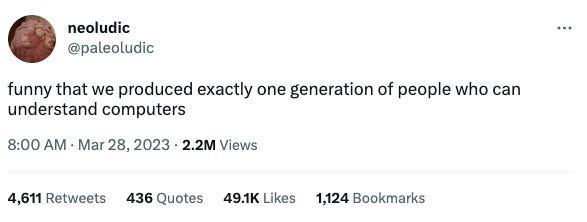
This tweet resonated with me:
(Tweet link: https://twitter.com/paleoludic/status/1640700448532226050?s=20)
It’s funny because the Gen X/Millennial straddle-generation that grew up with personal computers already being a thing, but not yet so common and commodified and abstracted-away as they are today, is the only age demographic that was told computers are the future, you need to learn to use and build and program computers, and that computers are at the root of all future technology—so don’t be left behind! Do computer things!
I grew up lucky, with a father who went to school for computers, making tic-tac-toe games by tangibly programming giant boxfuls of punch-cards, and who thus paid silly amounts of money to ensure we always had a computer at home growing up (I had no idea how fancy and rare this was at the time till much later).
Most people in my age-range, though, and maybe ten years older and younger, know at least the fundamentals of how computers work, how to turn things on and off to work out bugs, how to connect to the internet, and so on (for context: I’m about to turn 38-years-old).
This is generally less the case for folks more than ten years older and more than ten years younger, though, because the older folks came of age before computers were a serious thing (mostly just game-playing machines for the kids) and who were generally in positions where they didn’t need to learn how to use more than the basics, and it’s not the case for The Youngs because computer-related things have been so immensely streamlined and user-friendlied that you don’t really need to know how to mess with the internals (of the hardware or software): everything just kind of works almost always.
My anecdotal experience with this has been trying to help both older and younger friends set up their modems and routers (and similar computer infrastructure), neither group seeming to have any baseline knowledge about these topics, or interest in learning how to do any of it themselves.
But my understanding is that this is a broader issue in the workforce, as well, because people in my age demo are starting to age-out of certain types of work, and that leaves huge knowledge-gaps as younger people (who lack the knowledge and in some cases the desire to learn about seemingly outdated technologies) are asked to step in to fill those roles.
None of this is good or bad: it’s a neutral thing that happens with many technologies (and types of knowledge and cultural norms—especially those related to communication).
But it is an interesting thing to note, as it lines up with a theory of mine that certain types of knowledge and know-how are cyclical. So if you’re able to maintain a solid sense of how to hook up a modem/router and it’s not considered to be a valuable skill today, just wait a few years and you’ll find yourself in command of a powerful collection of (increasingly rare and thus appreciated) understandings.
Here’s a recent piece on this topic (with a great pull-quote from a 25-year-old in the headline: “Scanners are complicated”): https://www.theguardian.com/technology/2023/feb/27/gen-z-tech-shame-office-technology-printers
If you’ve found value in this email, there are several things you can do to support my work:
You can become a paid subscriber to Aspiring Generalist
Or you can support all my projects by becoming an Understandary member