A weekly collection of links to interesting things curated by Colin Wright.
The Disappearance of the Public Bench
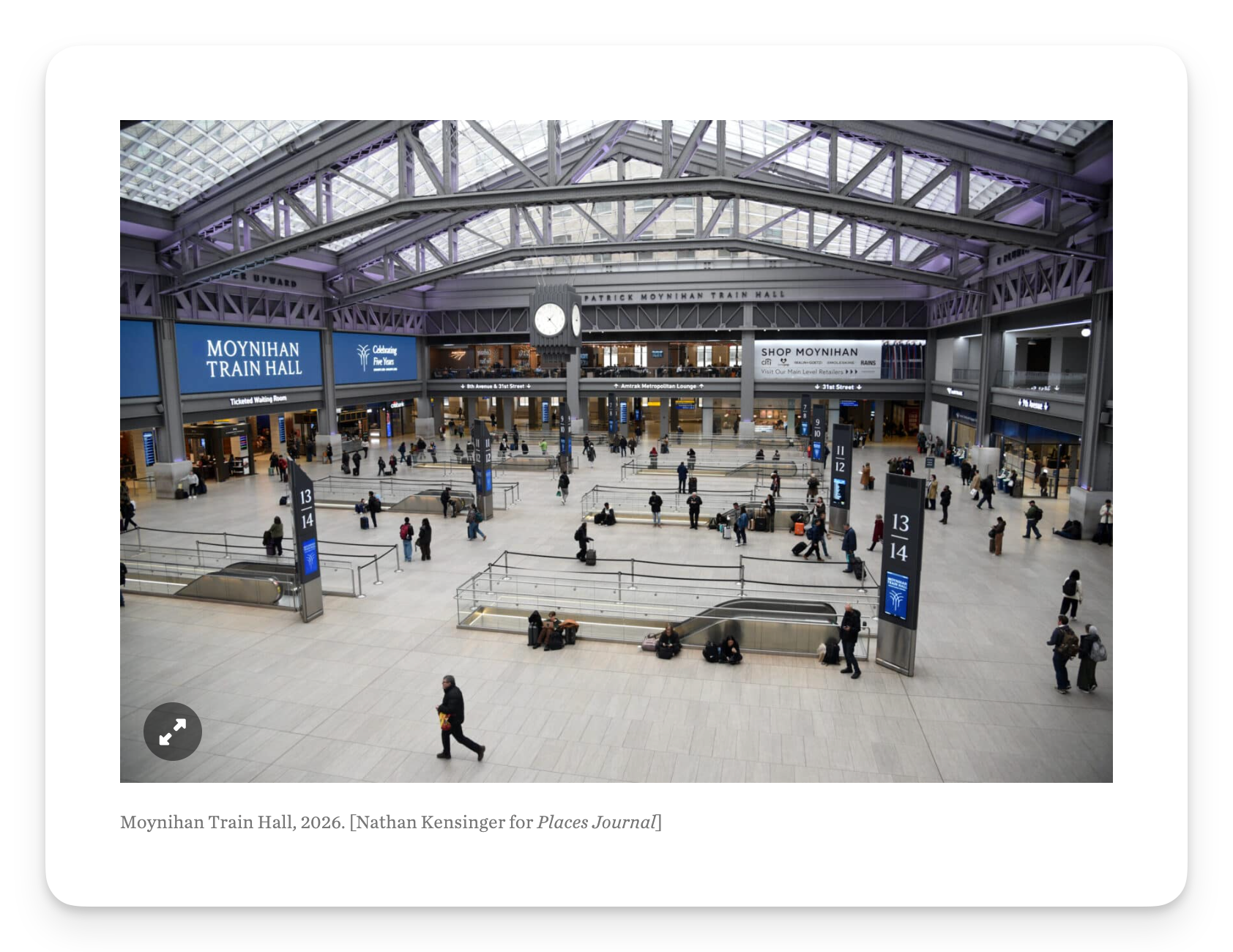
There’s just one thing missing from that picture of a commuter idyll: benches. Like most people in the hall, I was waiting for a train. There is a lounge for first-class Amtrak travelers and rewards club VIPs, and another for regular ticket holders. I was in the second category, but the ticketed waiting room looked uninvitingly crowded. It wasn’t anywhere near its official capacity of 320 people, but accounting for travelers’ luggage and the comfortable distance most of us prefer to keep from strangers, it seemed full enough. Boarding time, according to my rough estimate, was about 20 minutes away.
A Look Inside the Case That Enshrined Political Power for Billionaires
For a brief moment in American history, the rich didn’t control politics.
Back in 1974, in the wake of the Watergate scandal, Congress passed new campaign finance restrictions that would have largely eliminated the ability of wealthy people to buy elections. In addition to donor disclosure rules and contribution limits, the new legislation capped so-called “independent expenditures” on behalf of political candidates at $1,000 a year. There were even curbs on what rich people could spend to get themselves elected.
David Koch, a wealthy industrialist, was enraged.
“I have the right to spend whatever I choose to promote what I believe,” he later wrote, adding that the law “makes my blood boil.”
Meet the Literary Agent Who Invented the Book Auction
In 1952, literary agent Scott Meredith did the unthinkable: he sent the same manuscript to ten publishers at the same time, and single-handedly invented the book auction. At least, that’s how Meredith told it, and how his obituaries eventually reported it. The book industry thrives on lore, and Meredith was known to have a flexible relationship with the truth.
Not a week goes by without news of a high-profile auction breaking in Publishers Weekly. The auction has become a symbol a writer’s promise, of a publisher’s eagerness, of an agent’s ferocity. A buzzy auction sets the tone for a book, amping up expectations for success. It is publishing at its most capitalistic: high-risk, in hopes of high reward.
The problem with Meredith’s story of the first book auction is that it’s probably not true—at least, not strictly speaking. But a few facts emerge from the otherwise apocryphal account: the book auction wasn’t commonplace until the middle of the 1960s, and Meredith was an early adopter of the strategy. The auction initially caused quite a stir, upsetting tried and true gentlemanly practice. But it’s more likely that the auction took place in 1964, when Meredith sold a debut novel by a 24-year-old named Bruce Douglas Reeves— a novel for which Meredith and Reeves’s publisher, New American Library, clearly had high expectations that were ultimately unfulfilled.
Americans Still Opt for Print Books Over Digital or Audio Versions; Few Are in Book Clubs
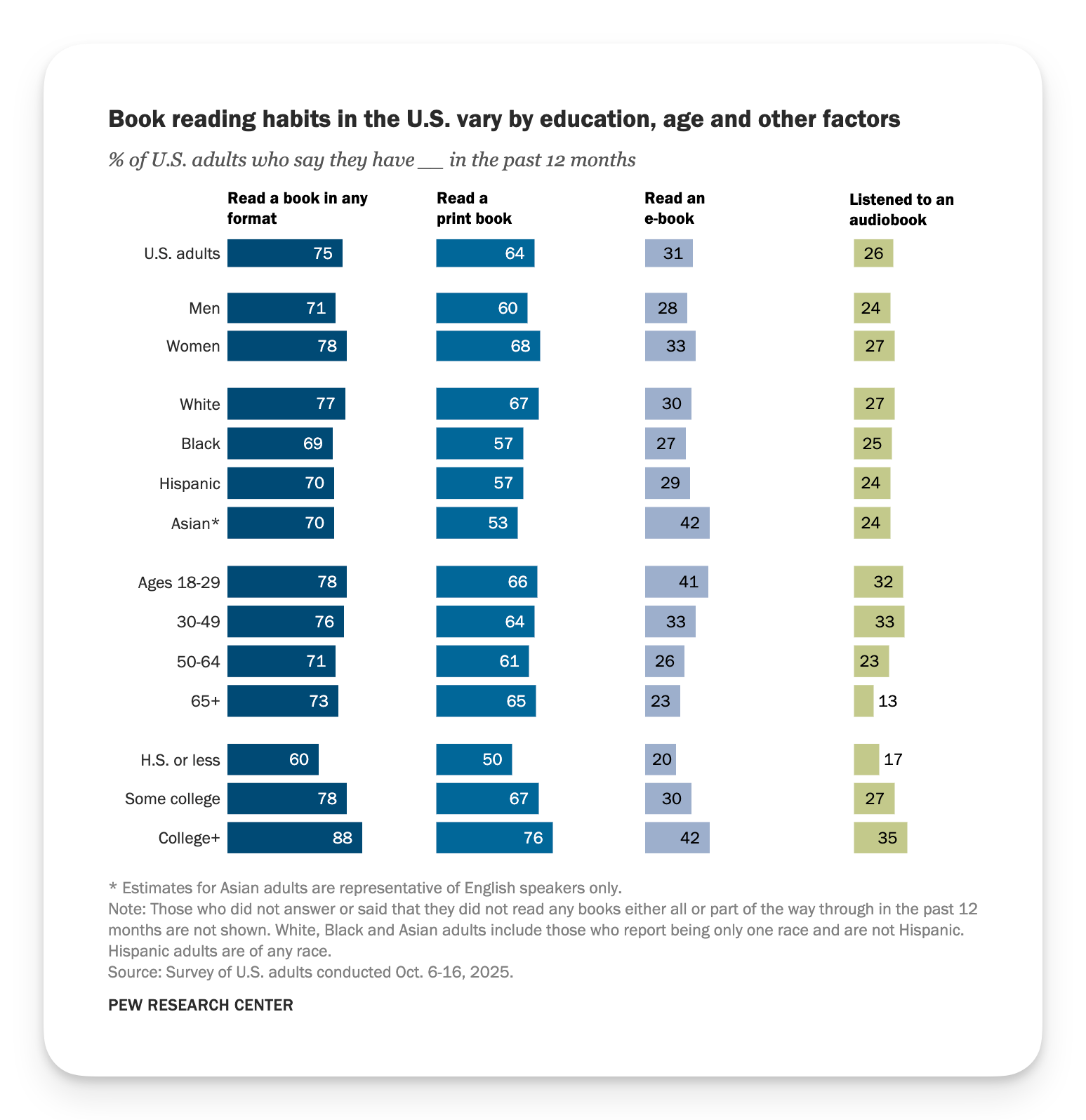
Digital books have grown in popularity over the past decade, but more Americans still read books in print than in digital formats.
Overall, 75% of U.S. adults say they have read all or part of at least one book in the past 12 months, according to a Pew Research Center survey conducted in October 2025. While book reading is widespread, the survey also shows that participation in book clubs is much less common.
EVs at 98.6% Share in Norway
The first quarter of 2026 saw plugin EVs at 98.6% share in Norway, up from 95.2% in Q1 2025. BEV share grew year on year (YoY), and PHEV share declined. Overall Q1 auto volume was 27,175 units, down some 14% YoY. The Tesla Model Y was the best-selling BEV in Q1.
2026 Q1 auto sales saw combined plugin EVs at 98.6% share in Norway, with full electrics (BEVs) at 97.9% and plugin hybrids (PHEVs) at 0.7%. These figures compare YoY against 95.2% combined, 90.6% BEVs and 4.6% PHEVs.
The 2025 Q1 baseline had seen a last chance pull-forward of non-BEV powertrains ahead of steeper taxes. Since then, both PHEVs and diesels have each dropped to around 1% market share (or less), with HEVs and petrol barely visible. For now, diesels are still slightly preferred compared to PHEVs, (1.1% vs 0.7% in Q1 2026), which is unfortunate, though not a major issue at these trace volumes.
A New Idea to Save the Climate? Dam the Bering Strait
Brightening clouds. Refreezing the Arctic. Floating a giant parasol in outer space. To the ranks of out-there ideas for countering climate change, two Dutch scientists have added this: building a 50-mile-long dam across the Bering Strait, the shallow waterway that separates Russia and Alaska.
In a study published on Friday in the journal Science Advances, the researchers show that, under certain conditions, such a dam could prevent a collapse of a network of ocean currents, known as the AMOC, that plays a central role in regulating Earth’s climate.
The AMOC (pronounced AY-mock) has weakened in recent decades, and a growing body of evidence suggests human-caused warming could someday cause it to shut down or slow significantly, with grave effects on the weather on multiple continents.
The new study is a “proof of concept,” not an action plan, one of its authors, Jelle Soons, a doctoral candidate at Utrecht University in the Netherlands, said. More research is needed to confirm that such a dam would work as intended and to assess its feasibility and environmental side effects, Mr. Soons said.