A weekly collection of links to interesting things curated by Colin Wright.
Meet Ski Map Artist James Niehues, the ‘Monet of the Mountains’
James Niehues sat down in his basement studio and took out his no.2 brush. With patient vertical strokes, he added the finishing touches to his latest canvas, Mad River Glen, a bowl-shaped valley, woven with ski trails, that sinks 2,000 vertical feet into Vermont’s Green Mountain Range. Autumn light filtered through the lonely high window, beyond which lay Denver, Colorado. Niehues didn’t pay it much attention. He rarely looks at real mountains when he’s painting.
There are probably tens of thousands of trees on the slopes of Mad River Glen, and Niehues has hand-painted every single one. He discriminates between conifers and deciduous trees, because skiers legitimately care about the difference. Trees at high altitudes are blue, caught in shade or lost in the ozone. Lower slopes are picked out in forest greens and pale sunrise gold. His mountains are usually frozen in a particular light, what American skiers call ‘Bluebird’, when the sun hits an acute angle and shadows catch on the snow, with a cloudless sky so blue it hurts the retinas.

Volcanic Eruptions Set Off a Chain of Events That Brought the Black Death to Europe
Researchers from the University of Cambridge and the Leibniz Institute for the History and Culture of Eastern Europe (GWZO) in Leipzig have used a combination of climate data and documentary evidence to paint the most complete picture to date of the ‘perfect storm’ that led to the deaths of tens of millions of people, as well as profound demographic, economic, political, cultural and religious change.
Their evidence suggests that a volcanic eruption – or cluster of eruptions – around 1345 caused annual temperatures to drop for consecutive years due to the haze from volcanic ash and gases, which in turn caused crops to fail across the Mediterranean region. To avoid riots or starvation, Italian city-states used their connections to trade with grain producers around the Black Sea.
This climate-driven change in long-distance trade routes helped avoid famine, but in addition to life-saving food, the ships were carrying the deadly bacterium that ultimately caused the Black Death, enabling the first and deadliest wave of the second plague pandemic to gain a foothold in Europe.
Will Pittsburgh Become America’s Most Important City Without a Newspaper?
Pittsburgh is the 28th-largest metropolitan area in the United States. It has a proud history as a center of industry and has transitioned into a major hub for medicine, robotics, and academia. It’s home to 10 Fortune 500 companies — more than 38 states can claim — and its big three pro sports teams have won 18 championships.
And soon it’ll be the largest American city without a real daily newspaper.
Today, the Pittsburgh Post-Gazette — “One of America’s Great Newspapers,” it has proclaimed on its front page for decades — announced it would be printing its final edition on May 3. But that’s not so it can boldly embrace the digital future — it’s to shut down completely.
‘Data Is Control’: What We Learned From a Year Investigating the Israeli Military’s Ties to Big Tech
In January this year, Harry Davies and Yuval Abraham first reported that Microsoft had deepened its ties to Israel alongside other major tech firms. Since then, the Guardian has published an award-winning series of investigations – in partnership with the Israeli-Palestinian publication +972 Magazine and the Hebrew-language outlet Local Call – that has revealed a symbiotic relationship between Silicon Valley and the Israeli military.
One investigation exposed an Israeli mass surveillance program scooping up virtually all Palestinian phone calls and storing them on Microsoft’s cloud services – setting off an inquiry that ultimately prompted the company to cut off Israel’s access to some of its technology. Another story revealed that the Israeli military created a ChatGPT-like tool to analyze data collected through the surveillance of Palestinians. Yet another revealed that Google and Amazon had agreed to extraordinary terms to clinch a lucrative contract with Israel.
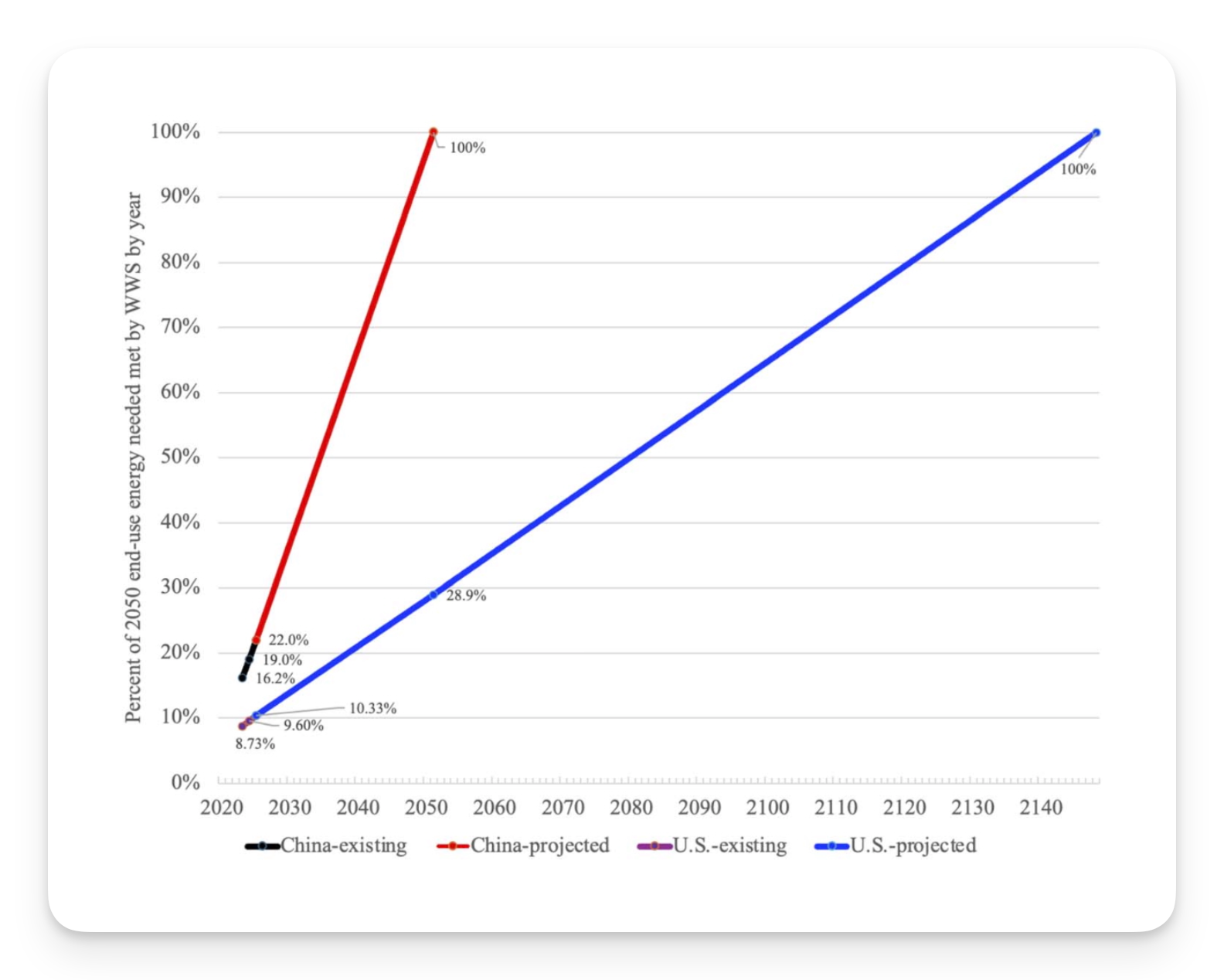
U.S. Would Reach 100% Renewable Energy by 2148 at Recent Pace
The U.S. could nearly eliminate its carbon emissions and air pollution by 2148 if it maintained a pace of adding 43 GW of renewables per year, set during the first seven months of 2025, and achieved “near-electrification” of each energy-using sector.
That finding and results for 149 other countries are presented in a paper by Stanford University Professor Mark Jacobson, published in the journal RSC Sustainability.
The “most substantial and encouraging finding,” the paper says, is the “rate by which China is transitioning its energy economy.”
U.S. Emissions Jumped in 2025 as Coal Power Rebounded
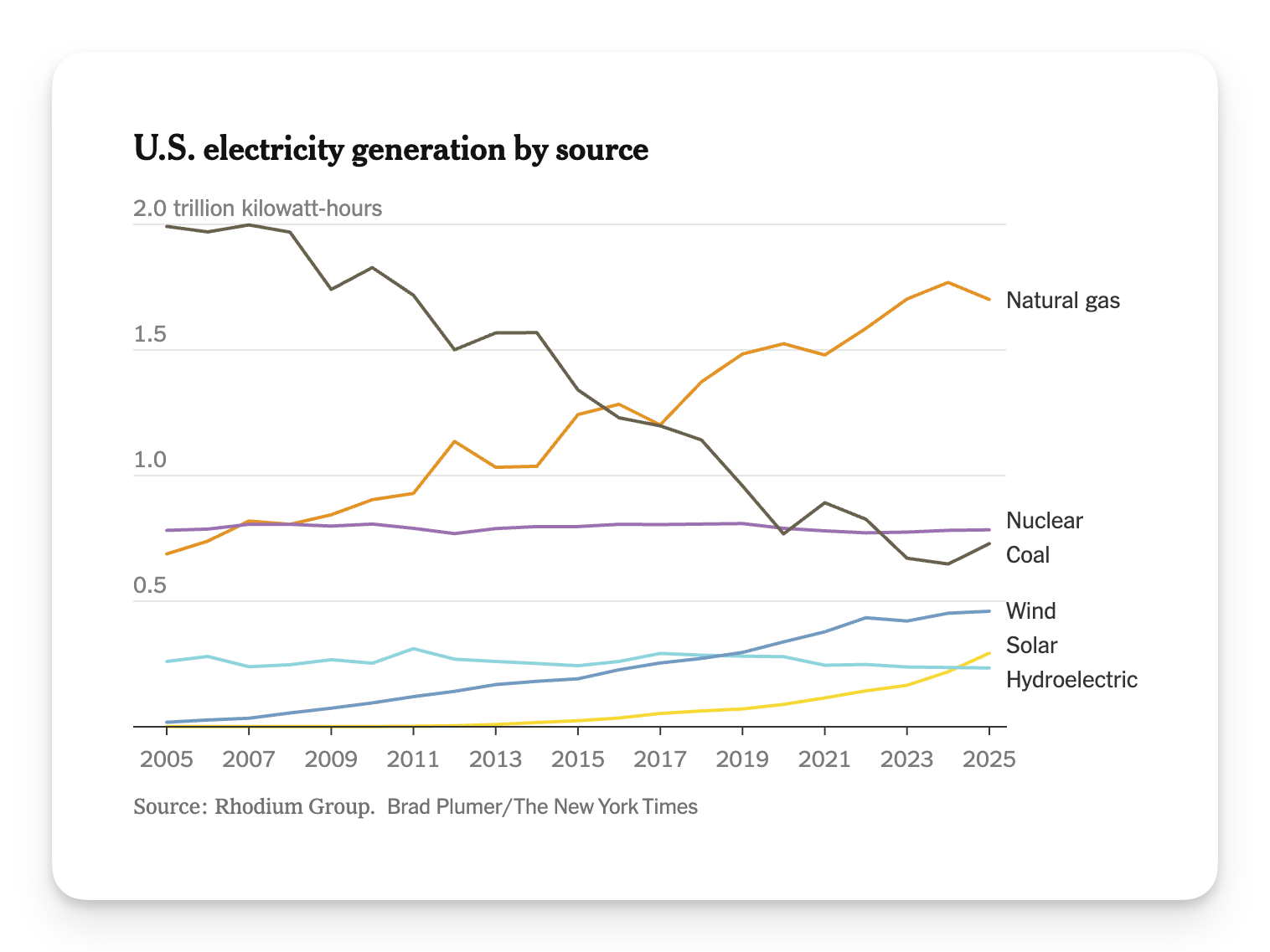
America’s greenhouse gas emissions increased by 2.4 percent in 2025 after two years of decline amid a resurgence of coal power, according to estimates published Tuesday by the Rhodium Group, a research firm.
The researchers identified two main reasons for the uptick. U.S. electricity demand grew at an unusually fast pace, driven in part by an expansion of power-hungry data centers for artificial intelligence. To meet that demand, electric utilities burned about 13 percent more coal last year than they did in 2024.
At the same time, colder winter temperatures led many buildings and homes to burn more natural gas and fuel oil for heating last year.