A weekly collection of links to interesting things curated by Colin Wright.
Astronomers Just Dropped the Largest High-Res 3D Map of the Universe
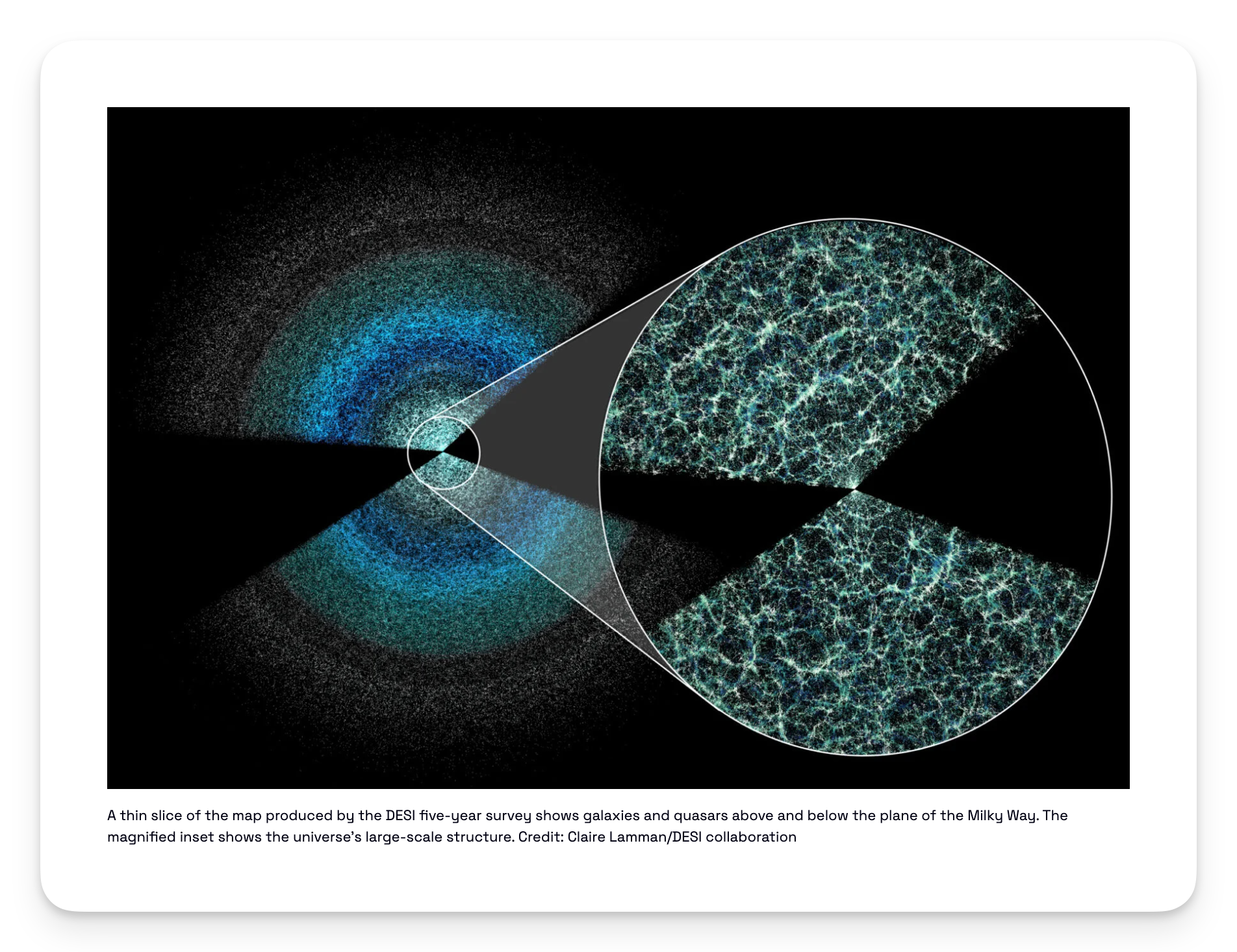
Since March, scientists have been keeping their eyes peeled as the Dark Energy Spectroscopy Instrument (DESI) started chipping away at the final tile of the largest 3D map of the universe to date. And last night, DESI officially finished recording more than 47 million galaxies and quasars and 20 million nearby stars—concluding a five-year groundbreaking journey.
In a statement today, the DESI Collaboration officially published the final results of the instrument’s first survey run: a high-resolution 3D map of the universe spanning over 11 billion years of cosmic history. Impressively, in five years DESI, based in Kitt Peak National Observatory in Arizona, collected cosmological data for “six times as many galaxies and quasars as all previous measurements combined,” according to the release. Astronomers will use this dataset to study the influence of dark energy, a hypothetical force that drives the acceleration of the universe.
Sperm Whales’ Communication Closely Parallels Human Language, Study Finds
We may appear to have little in common with sperm whales – enormous, ocean-dwelling animals that last shared a common ancestor with humans more than 90 million years ago. But the whales’ vocalized communications are remarkably similar to our own, researchers have discovered.
Not only do sperm whale have a form of “alphabet” and form vowels within their vocalizations but the structure of these vowels behaves in the same way as human speech, the new study has found.
Sperm whales communicate in a series of short clicks called codas. Analysis of these clicks shows that the whales can differentiate vowels through the short or elongated clicks or through rising or falling tones, using patterns similar to languages such as Mandarin, Latin and Slovenian.
The “Passive Income” Trap Ate a Generation of Entrepreneurs
I had coffee last year with a guy - I won’t use his real name - who told me he was “building a business.” I asked what it did. Dropshipping jade face rollers.
I made him say it twice.
Jade face rollers.
He’d found them on Alibaba for $1.20 each, and started selling them through Shopify for $29.99. Never used one himself. Didn’t really know what they were for - something about lymphatic drainage? Reducing puffiness? He said “lymphatic” the way you say a word you’ve only ever read and never heard out loud.
Some guy on YouTube said jade rollers were “trending,” the margins looked insane on paper, so he’d “built” a website with stock photos of a dewy-skinned woman rolling a green rock across her cheekbone and started running Facebook ads at $50 a day. Customers would email asking where their stuff was - shipping from Guangzhou, three to six weeks, sometimes way longer - and he’d copy-paste a response he found on a dropshipping subreddit. He had a Google Doc full of pre-written customer service replies.
Never talked to a single customer.
I swear to god.
Five months in, he was $800 in the hole.
LIV Golf in Crisis as PIF Considers Cutting Funding After $5B+ Loss
Saudi Arabia’s Public Investment Fund (PIF) is considering ending its funding of LIV Golf, but nothing has been decided, according to someone familiar with the sovereign wealth fund’s current thinking. PIF has spent more than $5 billion in an attempt to establish a challenger to the PGA Tour.
Without PIF’s backing, LIV would be severely challenged to continue in its current format. Representatives for LIV and PIF did not respond to requests to comment. The Financial Times was the first to report that PIF was considering cutting funding.
LIV Golf is currently in Mexico for the sixth tournament in its scheduled 14-event season. That competition is expected to go on as planned, someone familiar with the situation said.
What to Expect When You’re Expecting the End of the World
Jem Bendell had postponed his personal crisis long enough. For years, he’d been setting aside the worrying news about climate change he came across in a folder on his computer, waiting until he had the time (and emotional capacity) to look at it. In 2017, he took leave from his job as a professor of sustainability leadership at the University of Cumbria, in the United Kingdom, to finally dive in. He read that melting permafrost was releasing methane, a powerful greenhouse gas that speeds up warming — which in turn, melts more permafrost. It was a dangerous feedback loop that he had learned about as a student at Cambridge in the 1990s and had been told would likely start in 2050, if climate change went unchecked. Unfortunately, it arrived early.
AI Can Design and Run Thousands of Lab Experiments Without Human Hands
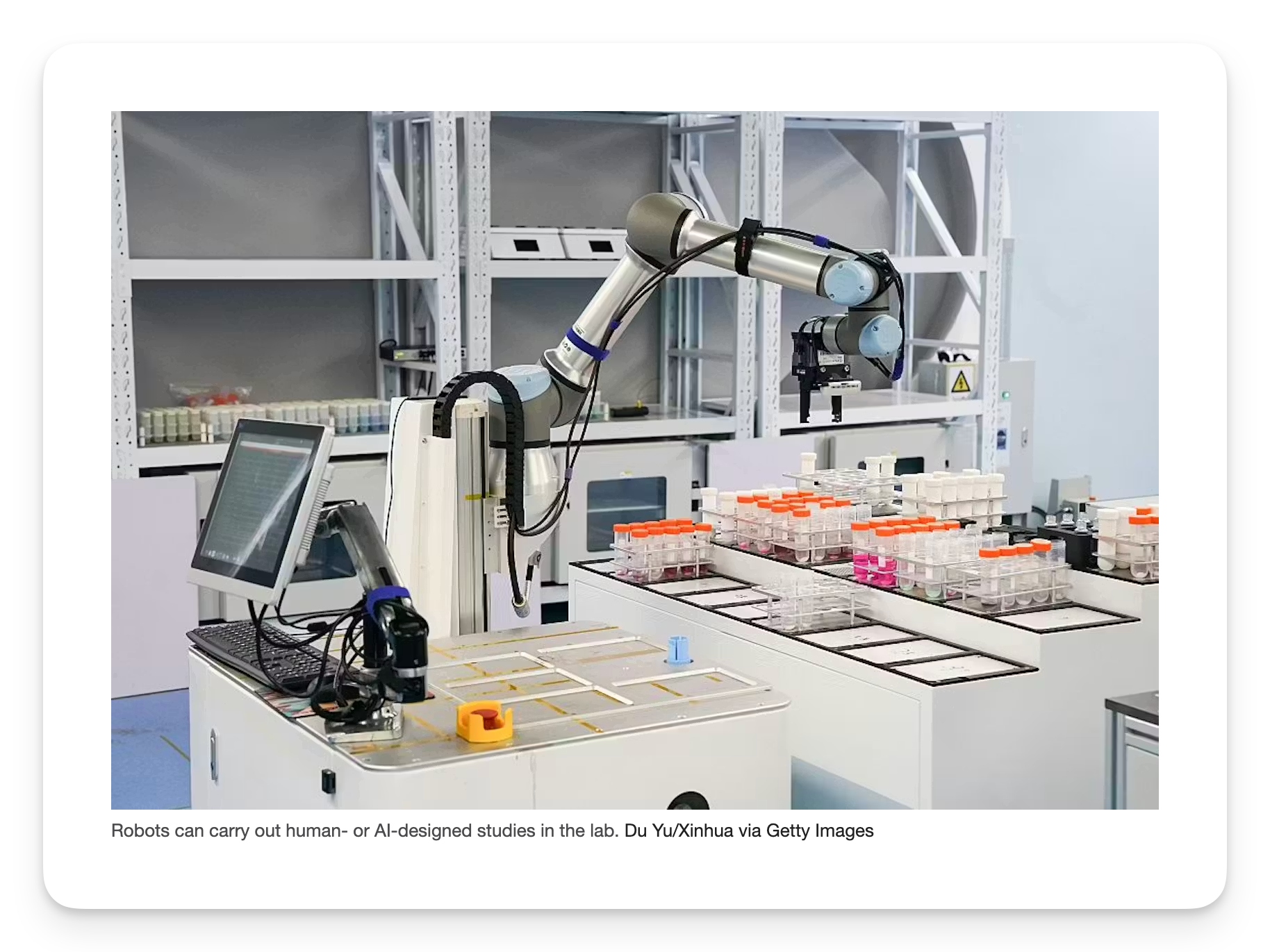
Artificial intelligence is rapidly learning to autonomously design and run biological experiments, but the systems intended to govern those capabilities are struggling to keep pace.
AI company OpenAI and biotech company Ginkgo Bioworks announced in February 2026 that OpenAI’s flagship model GPT-5 had autonomously designed and run 36,000 biological experiments. It did this through a robotic cloud laboratory, a facility where automated equipment controlled remotely by computers carries out experiments. The AI model proposed study designs, and robots carried them out and fed the data back to the model for the next round. Humans set the goal, and the machines did much of the work in the lab, cutting the cost of producing a desired protein by 40%.
This is programmable biology: designing biological components on a computer and building them in the physical world, with AI closing the loop.