

A weekly collection of links to interesting things curated by Colin Wright.
The Space Race’s Forgotten Theme Park
In 1964, in Huntsville, Alabama, anything seemed possible. Just 15 years earlier, the city had been, in the words of the local paper, a “ghost town,” a community of just 16,000 people spread over about 4.5 square miles. Now, it was “Space City,” a thriving metropolis that had annexed almost 46 additional square miles of the Appalachian hills to accommodate some 123,000 residents. The population boom could be credited almost entirely to Space Race–related installations, such as NASA’s George Marshall Space Center, which had made the northern Alabama city the starting block in America’s sprint to the moon.

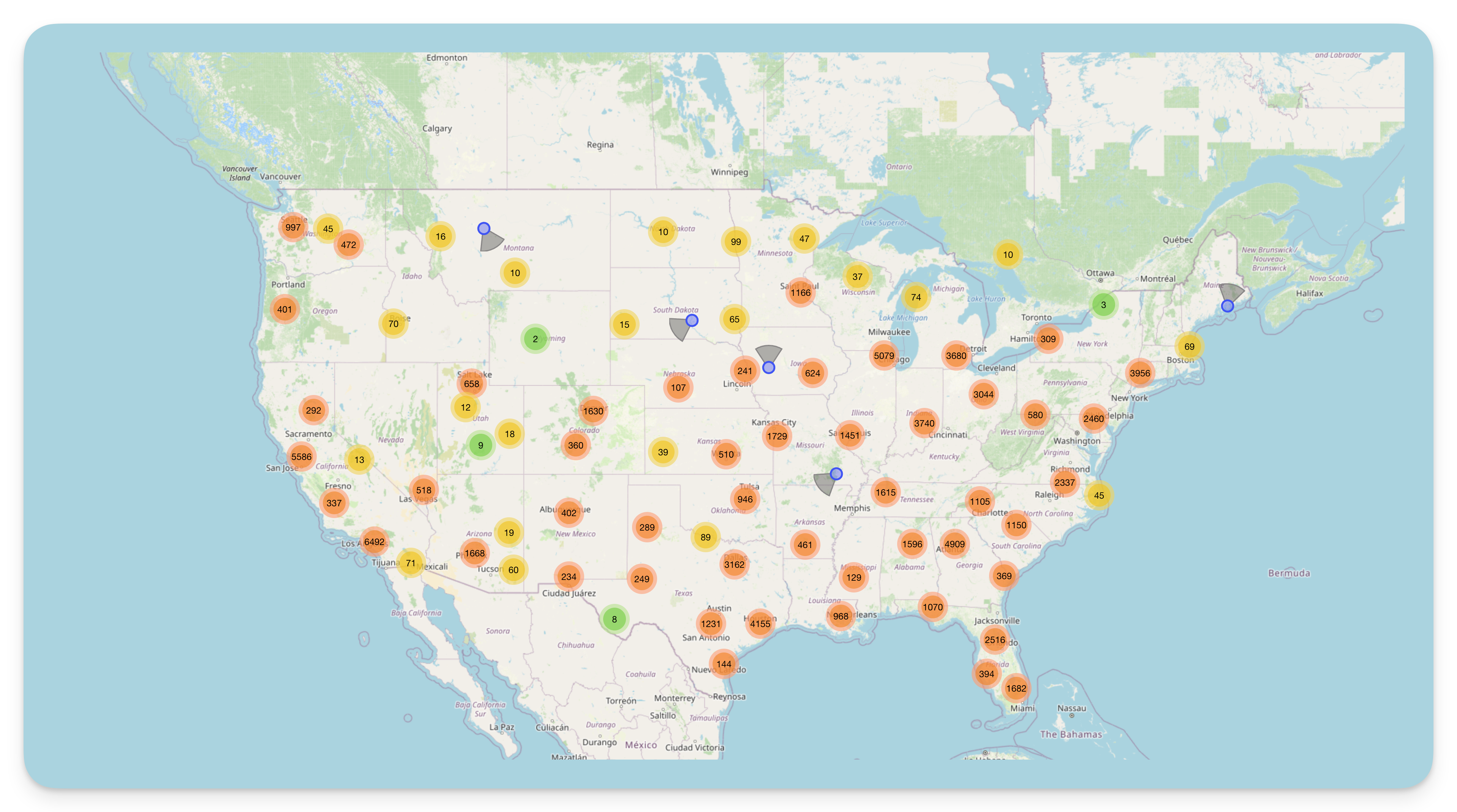
DeFlock Map
Automated License Plate Readers (ALPRs or LPRs) are AI-powered cameras that capture and analyze images of all passing vehicles, storing details like your car’s location, date, and time. They also capture your car’s make, model, color, and identifying features such as dents, roof racks, and bumper stickers, often turning these into searchable data points.
These cameras collect data on millions of vehicles regardless of whether the driver is suspected of a crime. These systems are marketed as indispensable tools to fight crime, but they ignore the powerful tools police already have to track criminals, such as cell phone location data, creating a loophole that doesn’t require a warrant.
GLP‑1 Drugs May Fight Addiction Across Every Major Substance, According to a Study of 600,000 People
A patient of mine, a veteran who had tried to quit smoking for over a decade, told me that after he started a GLP-1 drug for his diabetes, he lost interest in cigarettes. He didn’t use a patch. He didn’t set a quit date. He simply lost interest. It happened without effort.
Another patient on one of these drugs for weight loss told me that alcohol had lost its pull – after years of failed attempts to quit.
People struggling with many addictions, ranging from opioids to gambling, are reporting similar experiences in clinics, on social media and around dinner tables. None of them started these drugs to quit. This pattern of people losing their cravings across a broad range of addictive substances has no precedent in medicine.
That Red Roof! Those Tiffany Lamps! It’s a Pizza Hut From the Past
Once a common sight across the country, these old-school, low-slung buildings had largely disappeared as the restaurant chain modernized its stores and focused on takeout. Mr. Pujol, a journalist who documents retro American highway culture, says he “freaked out,” and swerved into the parking lot.
He had not discovered an abandoned relic from the Reagan era. As a plaque near the door explained, this restaurant in Tunkhannock, Pa., was a Pizza Hut Classic. The interior design and menu had been painstakingly engineered to replicate the Pizza Huts of the 1980s and ’90s, when families and friends settled into red-vinyl booths on a Friday night to eat deep-dish pan pizza and drink Pepsi from red plastic cups.

Scientists Fed Biochar to Cows. Here’s What Happened
Led by a team of Swiss researchers, the study took a group of eight dairy cows and fed them a diet containing trace amounts of biochar, about 1%. The feeding trial had two periods of 35 days each. In one, half the cows received the biochar additive, and the other half did not. In the second, the researchers switched the two groups of cows, so that each cow ultimately acted as its own control.
The researchers then gathered cow dung for several days over the course of the experiment. These samples were dried and three different methods used to analyze the biochar fragments within the dung. The goal was to determine how much of that biochar had remained intact, both structurally and chemically.
The answer was: a surprising amount. From the analysis, the researchers calculated that between 70 and 90% of the biochar that cows consumed in the study survived their famously robust digestion, resisting decomposition. What’s more, an estimated 98% of that biochar which made it out the other side was intact—both in terms of its physical structure and its chemical makeup.
Why Western States Are Pushing for Plug-In Solar
Last October, Colorado state Rep. Lesley Smith was in Germany, visiting her husband’s family. While strolling around her sister-in-law’s neighborhood, she glimpsed a solar panel hanging off an apartment building balcony — something she’d never seen before. “Oh, my goodness, look at that,” Smith remembered thinking.
Small-scale household solar is common in Germany, where an estimated 4 million units have been installed. It’s a simple concept: Just plug one or two solar panels attached to a microinverter into any household outlet, place the panels outside on a patio or balcony, and you can generate enough power to offset around 15% to 20% of your energy usage. The gear costs several hundred dollars and can be set up almost anywhere, so renters and homeowners alike can enjoy the cost savings and climate benefits of clean energy.
But in the U.S., a tangle of regulatory and market constraints has prevented widespread adoption of the technology, known as balcony or plug-in solar.