

A weekly collection of links to interesting things curated by Colin Wright.
The Medieval Frog: From Healing Charm to Cautionary Tale
Frogs appear frequently in medieval medical writings as useful ingredients. Dinkova-Bruun traces their presence in De medicamentis liber, a fifth-century collection of remedies by the Gallo-Roman physician Marcellus Empiricus. His manual catalogues hundreds of treatments from head to toe, combining herbs, animal parts, and ritual actions in equal measure. Among the many creatures pressed into service, the frog features in eleven recipes, often for ailments that were both common and mysterious: earache, ulcers, dysentery, and toothache.
Some of these cures verge on the surreal. One treatment instructs the physician to place a living frog on the patient’s stomach so that the illness might pass into the animal. Another prescribes frog bile for ulcers and frog blood for eye irritation. To relieve joint pain, the patient was told to apply crushed frogs as a poultice. The most striking example, however, is a charm for toothache:
“When the moon is waning on the day of Mars or on the day of Jupiter, say these words seven times: ARGIDAM MARGIDAM STVRGIDAM. You will eliminate the pain when, while standing in the open air, on fresh ground and wearing shoes, you grasp the head of a frog, open its mouth, spit in it, and ask it to take the toothache away with it. Then release the living [frog] and do so on a good day and at a good hour.”

Scientists Discover Ingredients for Life Just Beyond our Galaxy
Based on data obtained by MIRI’s Medium Resolution Spectrograph, Sewilo and her team identified five COMs in the ices surrounding the young protostar ST6. This included acetaldehyde, acetic acid, ethanol, and methyl formate, all of which have applications here on Earth. Whereas methanol and ethanol are common types of alcohol, methyl formate and acetaldehyde are used primarily in industrial chemicals, while acetic acid is the main component in vinegar. These molecules have all been detected in stellar nurseries and protoplanetary systems within our galaxy. However, this was the first time that ethanol, methyl formate, and acetaldehyde were detected in a neighboring one. In addition, acetic acid has never been conclusively detected in ices in protoplanetary systems until the release of this study.
Nvidia Becomes First Company to Close Above $5 Trillion Market Cap
Nvidia (NVDA) on Wednesday became the first company in history to top a $5 trillion market valuation at the start of the trading day and hold on to it through the close.
The company reached the milestone after comments from President Trump on Wednesday ahead of a planned meeting with CEO Jensen Huang added to optimism around prospects for Nvidia’s sales in China.
Trump told reporters Wednesday that he and Huang would be “speaking about Blackwells,” Bloomberg reported, referring to the company’s AI chips, a version of which could win approval for export to China.
Why Tech Bros Are Getting Face-Lifts Now
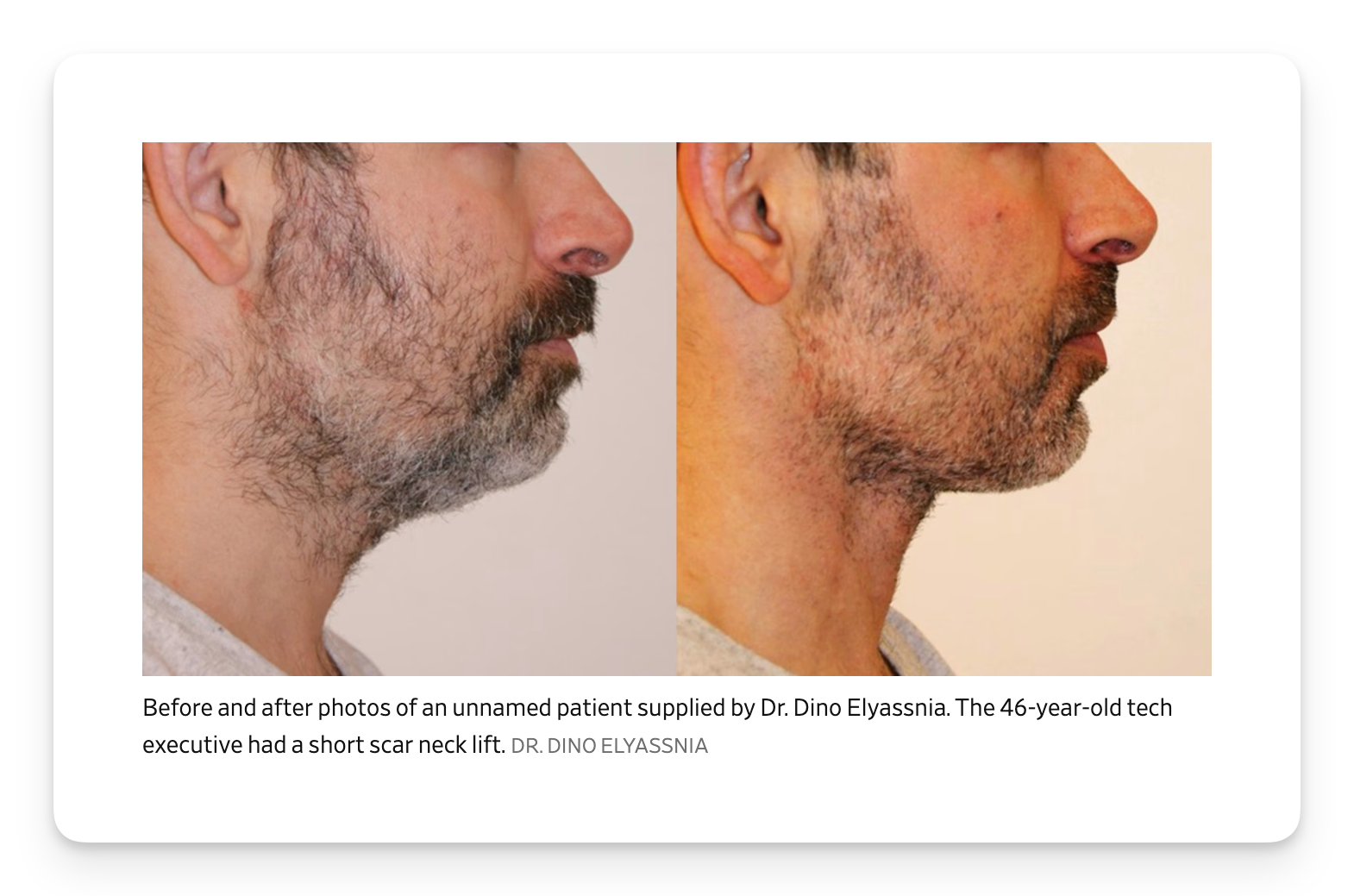
Tech is a young person’s game. In a 2024 talk, Keith Rabois recounted advice his fellow investor Peter Thiel once gave him: “You can’t hire anyone over 30.” It’s unsurprising, then, that men in tech are increasingly spending thousands of dollars on procedures such as “mini face-lifts,” neck lifts and eyelid lifts to beat the signs of aging, according to plastic surgeons. Yes, the latest addition to the tech-bro look is a brand-new face.
“Our society has traditionally put more pressure on women to look young, but now everyone is feeling it—especially in Silicon Valley, where you start to be labeled ‘irrelevant’ if you look old,” said Dr. Timothy Marten, a San Francisco plastic surgeon.
Dr. Ben Talei, a Beverly Hills plastic surgeon (who charges around $125,000-$150,000 for his advanced face- and neck lift), has seen demand from tech guys increase fivefold over the past five years. San Francisco-based plastic surgeon Dr. Andrew Barnett says requests for face-lifts from men in tech have jumped roughly 25% from pre-Covid levels, while eyelid surgeries are up by 50%. He said the most notable increase appears to be among men in VC and private equity. The fact that tech guys have access to funds helps, added Barnett, whose face-lifts cost $40,000-$65,000.
China Has Added Forest the Size of Texas Since 1990
While the world is continuing to lose huge areas of forest, mostly in the tropics, woodlands are making a comeback in some countries. Since 1990, China has added more than 170 million acres of forest, an area roughly the size of Texas, according to a new U.N. report.
Overall, the world has lost around 20 million acres of forest a year for the past several years, putting it far off course from an international goal to end deforestation by the end of this decade. The biggest drivers of deforestation are the clearing of land for farming and ranching and, to a growing extent, fires and drought fueled by warming. Brazil, Indonesia, and the Democratic Republic of the Congo are seeing the largest areas of forest destroyed.
However, in large parts of the world forests are regrowing. In richer countries, where farming has become more efficient, deforestation has slowed or even reversed. In many wealthy nations — the U.S., Canada, Russia, and much of Europe — forests are making a comeback, according to the U.N. assessment. As India and China become more developed, they too are seeing forests return. Even as fires and drought destroy some forest, on balance, these countries are adding trees.
Extinction Rates Have Slowed Across Many Plant and Animal Groups, Study Shows
Prominent research studies have suggested that our planet is currently experiencing another mass extinction, based on extrapolating extinctions from the past 500 years into the future and the idea that extinction rates are rapidly accelerating.
A new study by Kristen Saban and John Wiens with the University of Arizona Department of Ecology and Evolutionary Biology, however, revealed that over the last 500 years extinctions in plants, arthropods and land vertebrates peaked about 100 years ago and have declined since then. Furthermore, the researchers found that the past extinctions underlying these forecasts were mostly caused by invasive species on islands and are not the most important current threat, which is the destruction of natural habitats.
The paper argues that claims of a current mass extinction may rest on shaky assumptions when projecting data from past extinctions into the future, ignoring differences in factors driving extinctions in the past, the present and the future. Published in the journal Proceedings of the Royal Society of London, the paper is the first study to analyze rates, patterns and causes of recent extinctions across plant and animal species.