

A weekly collection of links to interesting things curated by Colin Wright.
The Social Cost of Being a Morning Person
Gradually, my early-to-bed, early-to-rise nature has shaped our household’s rhythms. Mornings are my domain. I make breakfast, feed our three pets, and push everyone out the door. When my two daughters were younger, I’d make their lunch and walk them to school, my mug of coffee long drained. My husband prefers to stay up late, so he handles the evening-pickup runs, the printer problems that invariably surface the night before something is due, the random tidbits of adolescent info that seep out just as our kids are flagging. It’s an efficient arrangement, but it has created an unintended hierarchy in which I get our daughters’ foggy beginnings and he gets their vulnerable nighttime moments.
Doctor, Doctor, Give Me the Shmooze
Ayear ago, Traedana Odom didn’t like to go out much. She was struggling with depression, lived more than an hour away from her family, and mostly left the house to catch a movie or go to her medical appointments.
That changed last December, when her doctor suggested she try something new, and connected her to the Art Pharmacy. It’s a new company that connects healthcare organizations and community groups with the goal of bolstering patients’ participation in social and artistic activities that can benefit their health. A play was the first of a dozen “doses” of the arts prescribed to the 35-year-old. She’s since joined a monthly paint-and-sip style class, and says they’ve “got me opening up.” She’s laughing with strangers and coming out of her shell, and says her depression has lessened. “Before I started the Art Pharmacy, I really didn’t want to befriend anyone,” she tells me. “I’m actually getting out of the house more, and I actually made a friend at one of the events.”
Aging as a Disease: The Rise of Longevity Science
Science fiction, of course, includes many examples of extended lifespans, from Heinlein’s Lazarus Long to the reincarnating Time Lords of Doctor Who. But novelists usually focus on the extremes: the eons-old travelers who are functionally immortal compared to our own mere span of decades. Longevity researchers, by and large, chase a more proximal goal. What would an extra year mean to you, if it were a functional and healthy year? What if you could have five more years, or 10? What would it mean for society if people worked an average of 1, 5, or 10 more productive years?
But that’s still an incredibly broad target. Eradicating a specific childhood disease might have the same, or greater, impact on overall lifespan curves as finding a miracle drug to grant an extra year or two at the end of life to everyone who doesn’t succumb in childhood. The longevity crowd at Progress Conference 2025 played in both arenas: exploring the impact of specific technologies or treatments on longevity, and focusing on aging qua aging as its own disease.
Med Spa Nation
On a recent trip to grab groceries in my New York City suburb, I drove by a small, simply marked door for Westchester Laser Associates, which is in the same plaza. A few steps away, a large sign between two awnings reads “Ject.” They’re two med spas competing for customers—although Ject would seem to have the upper hand, with a huge storefront and minimalist-chic aesthetic that’s practically screaming (or, rather, whispering) Jenni Kayne. Both blend seamlessly among the Chopt, SoulCycle, and Starbucks in the shopping center—grab a salad, go for a spin class, sip an Americano, get an injection of botulinum toxin.
A Climate ‘Shock’ Is Eroding Some Home Values, New Data Shows How Much
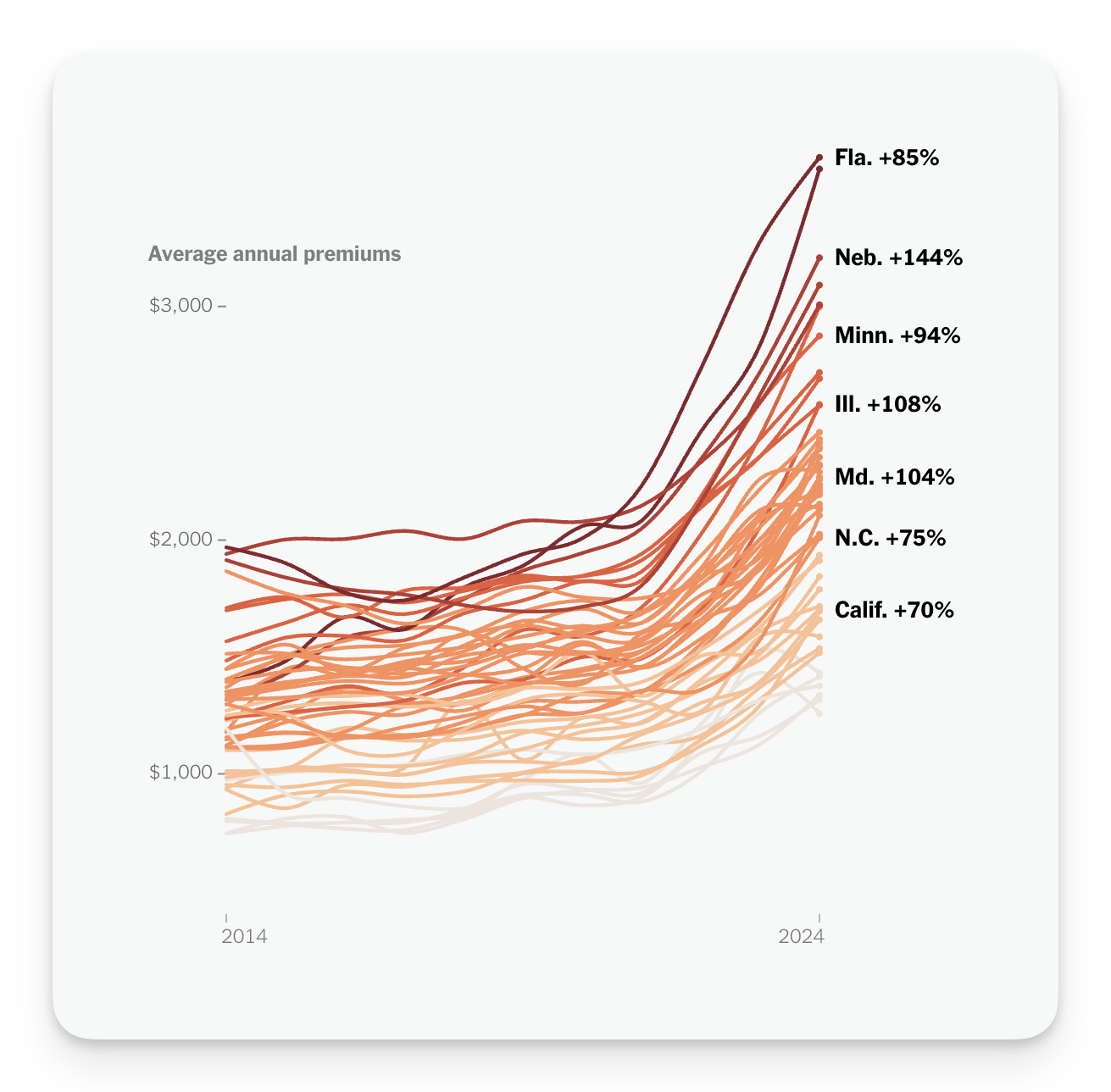
It’s not just the hurricane-prone coasts that have been affected by the reinsurance shock. In Colorado, where wildfires and hail pose the biggest threats to homes, the average homeowner’s premium has more than doubled in the last decade and median premiums have increased 74 percent since 2020.
Steve Hakes, an insurance broker with Rocky Mountain Insurance Center in Lafayette, Colo., has seen clients consider homes in wildfire-prone areas, only to back out when they can’t find affordable insurance. High prices and limited availability have pushed him to advise buyers to look for insurance early in the homebuying process.
And in California, 13 percent of real estate agents surveyed by an industry trade association said they’d had deals fall through in 2024 after buyers couldn’t find affordable insurance coverage.
The Archaeologist’s Guide to Colonizing Other Worlds
Models help scientists understand everything from the particles that make up the universe to massive superstructures of galaxies at the beginning of time. But sometimes they model more mundane, though perhaps even more complex, features—including the course of human civilization. A new paper by Thomas Leppard of the International Archaeological Research Institute and his co-authors, all of whom are also archaeologists, proposes applying a model of how humans expanded to the different islands across the Pacific Ocean during their early migration to glean insights into how humanity should manage our colonization of space.
Their paper, which is published in Acta Astronautica, uses island archaeology to outline eight different lessons that can impact the success of ongoing space colonization efforts. Considerations for space colonization go beyond just the technical abilities to live on the surface of another world—they have to consider resource availability, genetics, and cultural ties as well.
Love this perspective! I totally get the morning routine thing. My pilates is sacred, and my boyfriend is such a night owle.