A weekly collection of links to interesting things curated by Colin Wright.
The Oldest Building on Every Continent
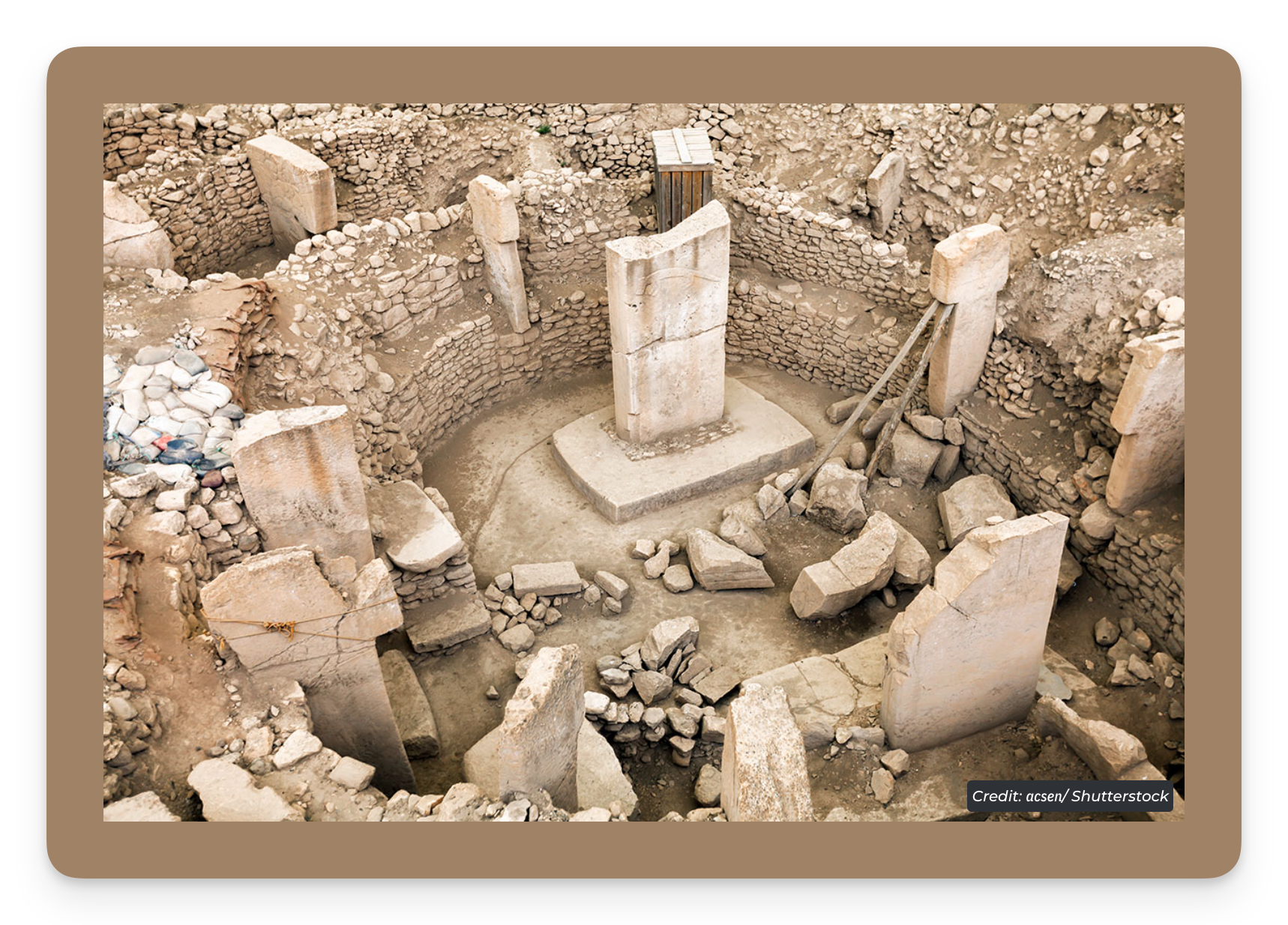
Often called the world’s oldest temple, the ancient site of Göbekli Tepe was discovered in southeastern Turkey in 1994. Linked to the emergence of agriculture and the move from foraging to farming, the site includes circular structures with massive stone pillars, many of which were decorated with human and animal figures. There are also domestic structures, quarries, and cisterns or wells at the site. Although it is unclear if the prehistoric stone structures were actually temples, it is clear that Göbekli Tepe is the oldest evidence yet of permanent human settlement.
The Coolest Places Around the World From Where You Can Mail a Letter
On occasion, and only if you’re lucky, mailing a letter will involve a little more than a walk to the mailbox on the nearest street corner. But around the world, a handful of post offices occupy locations so unusual they’ve become tourist attractions in their own right. One has been hiding inside a Slovenian cave since 1819 and another sits in a houseboat bobbing on Dal Lake in Kashmir surrounded by shikara boats; there’s one perched on the slopes of Mount Everest, and there’s a place where you can send postcards from a mail office submerged underwater in Oceania. All of these are fully-functioning post offices. Most operate all year round. Many even offer special stamps, postmarks, compact museums, and souvenir shops. On a visit, you can scribble out a quick postcard or two, drop them in for friends or family back home, and hope your mail finds them well—and you can say, “I’ve been there.” Here are 10 postal landmarks around the world to send snail mail from.

Breakdown at the Racetrack
In the fourth race of the day on Nov. 28, 2024, Hoyte’s mount was a two-year-old bay filly named Speight Rasees. The horse was like Hoyte—not some blue-blooded, highly touted prospect, but an animal squarely in the racetrack’s middle-class. She had been bought as a yearling at auction for just $7,379 USD, far below the median selling price of $30,000, and had run her first race just a few weeks earlier, finishing well back of the winner. She was a horse who would never become a star, perhaps never win a stakes race. Which is to say she was like so many of the 1,750-odd horses at Woodbine—animals necessary for the business of the track but whose ceiling for success might be scraping together some purse money for their owners in a few end-of-season races.
When the bell rang, Speight Rasees got out of the starting gate cleanly. As the horses made their way down the backstretch, she was running in second.
“Going down the back, everything was good,” remembers Hoyte. Sometimes, he says, there’ll be an early indication that something’s not right with a horse. With Speight Rasees, disaster came out of nowhere. “There wasn’t no warning,” he says. “[Her] front leg just snapped.” One moment the horse was charging around the track, making the turn for home. The next, she was plummeting toward the ground headfirst, her momentum sending her tumbling in an awful tangle of limbs.
New Triangular Relations
In response to President Trump’s “tariff war,” Mexican President Claudia Sheinbaum’s economic team recently presented a draft decree that would apply 1,400 new tariffs of up to 50 percent on purchases from China. These drastic measures reflect the intense pressure on Mexico to meet US demands of limiting the role of China in Mexico’s foreign trade. The US remains the largest market for Mexican goods, and exclusion would have severe consequences for Mexico’s economy.
The Trump tariffs are the latest iteration in America’s “security-shoring” strategy, which subordinates trade relations to US national security interests. The Biden administration initially defined this strategy with three pillars: investment in strategic sectors; alignment with allied countries; competition with China in technological areas such as semiconductors, artificial intelligence, and quantum technologies. Through security-shoring, the US has attempted to pressure trade partners to limit ties to China, placing third countries in a difficult position. Mexico must navigate complex relationships with its two most important trading partners, the two largest economies in the world. This formulation is what I refer to as “new triangular relations” between Mexico, the US, and China.
Russia’s Coal Collapse Marks The End Of Fossil Fuels’ Post-War Illusion
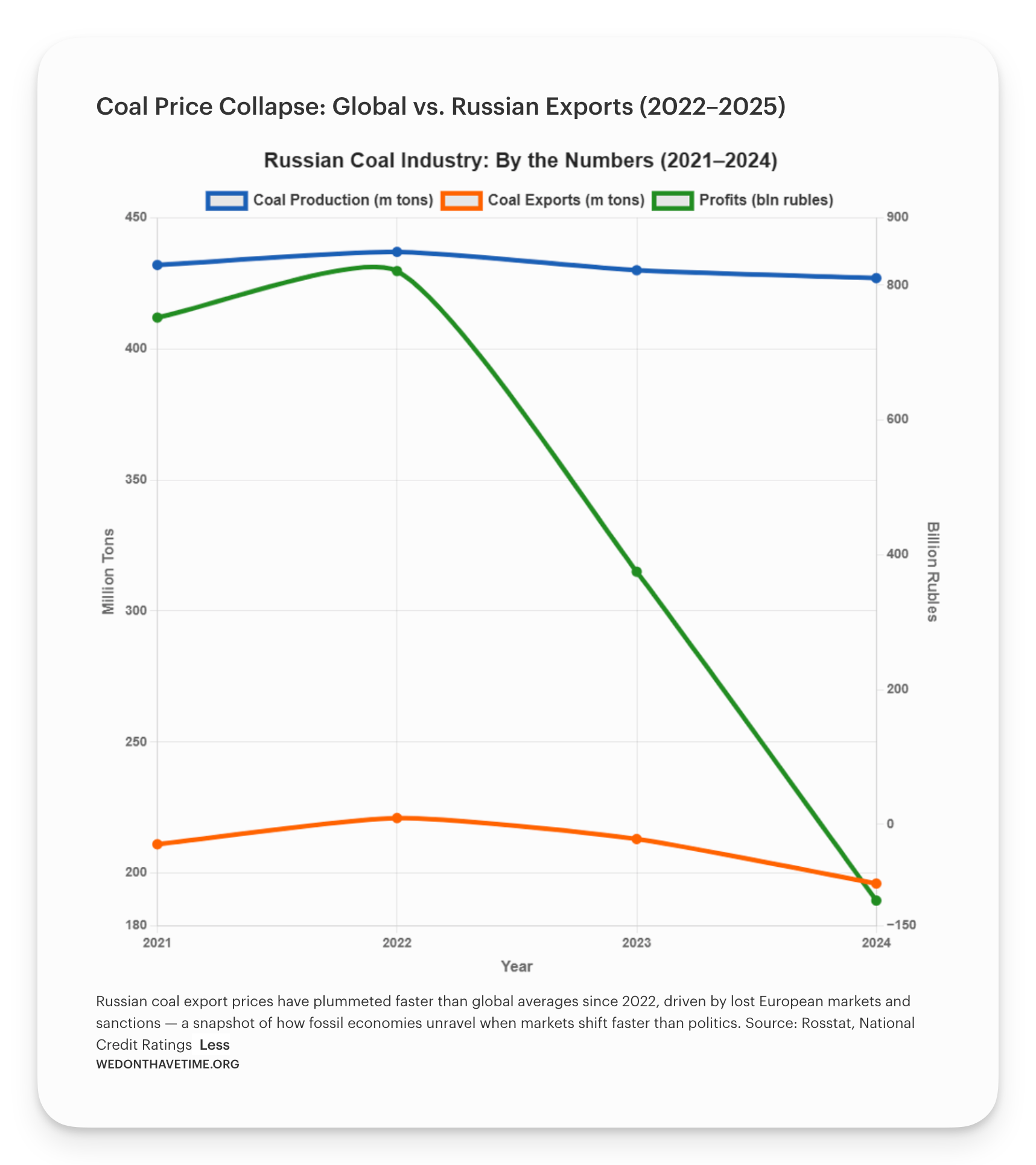
Russia’s coal collapse marks the breaking point of the fossil era. With thermal-coal prices down nearly 80 percent from their 2022 peak and over half of Russia’s producers now losing money, Moscow’s lifeline industry is imploding — even as renewables, batteries, and storage become the fastest-growing assets in the world economy.
According to the Financial Times, the sector lost Rbs 225 billion (≈ US$2.8 billion) in the first seven months of 2025 — more than double 2024’s total losses — as exports vanished and subsidies fail. Twenty-three coal companies — about 13 percent of the national total — have already shut down, and another 53 are at risk of closing. Once Russia’s fourth-largest export, coal has become its worst-performing industry in more than 30 years.
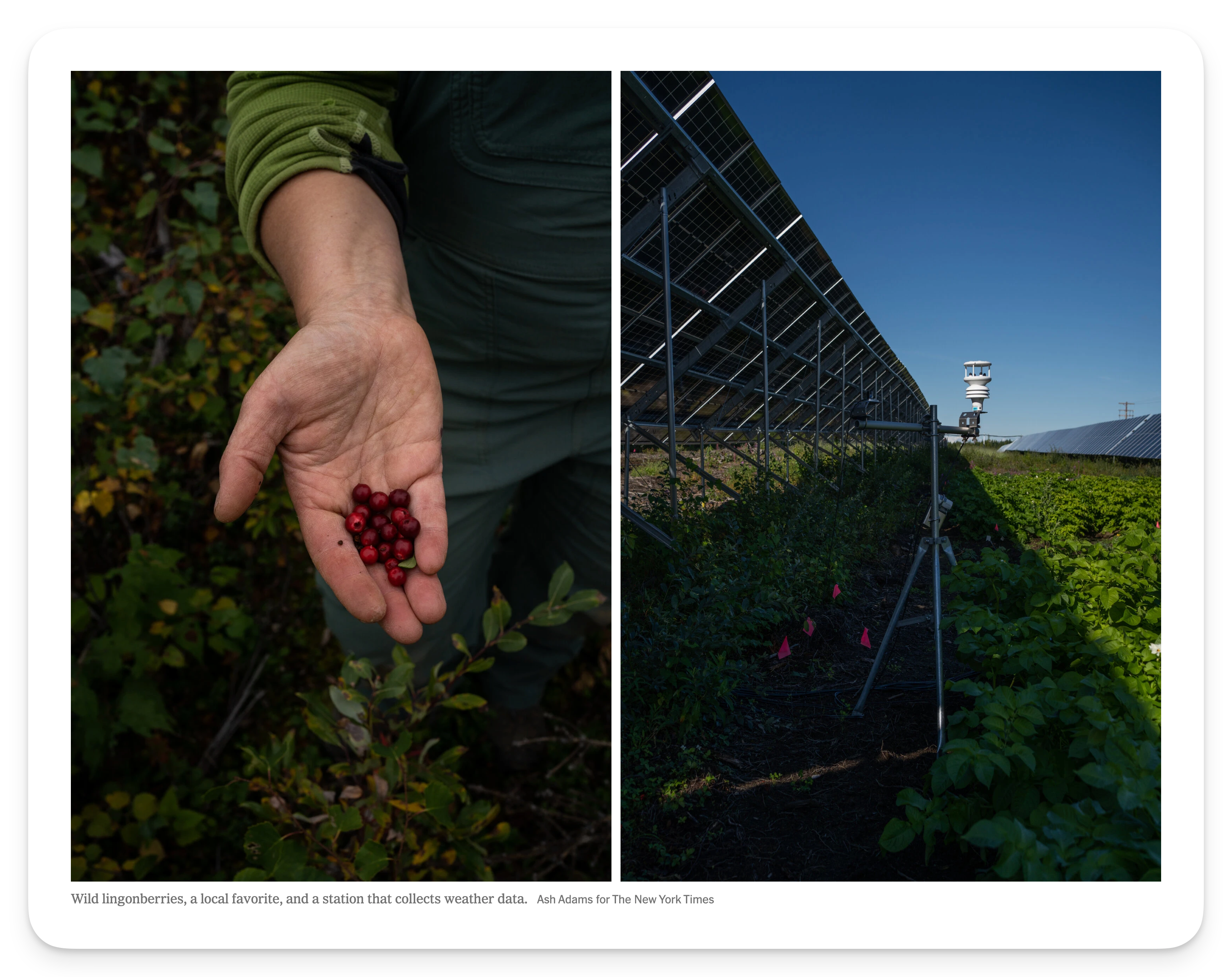
Alaska Tests a Theory: Solar Farms Help Nearby Crops Grow
In Alaska, land is easy to come by. But energy and food are not.
So when the largest solar farm in the state, which can power 1,400 homes, was built two years ago, researchers wanted to test whether food could be grown between the arrays. The rows of panels on the 45-acre site are set 50 feet apart, much wider than at lower latitudes, and they collect solar power on both front and back in order to capture the maximum amount of summer sunlight as the sun dances across the horizon all day and all night.
This test case in Houston, Alaska, for combining food farms and solar farms, a practice called agrivoltaics, was designed as a model for other communities seeking energy and food security. Europe, which has ambitious climate goals and limited land, has been exploring high-latitude agrivoltaics in recent decades, but this is the first American project on an industrial-scale solar array.
“The purpose is to study how food and energy can be produced together, in a place where food and energy cost a lot of money,” said Glenna Gannon, an assistant professor at the University of Alaska Fairbanks who led the research. “Self-sufficiency is really important in Alaska.”