

A weekly collection of links to interesting things curated by Colin Wright.
The Coloradans Exercising Their Right To Die—and a Doctor Who Helps Them Find Peace
Most of the spring was a shadow in Alan Koziel’s mind. Still, he remembered his wife’s birthday in late March and the call that afternoon from his doctor at the VA hospital in Aurora. A PET scan a few weeks later revealed that the cancer was moving toward his lungs. In May, Alan learned the disease had spread to 11 parts of his body. “It’s everywhere,” his wife, Patricia, said.
Alan had developed small-cell carcinoma, a particularly aggressive form of lung cancer. An oxygen tank rolled behind him like a child’s toy. He took fistfuls of pills to lessen the pain. A doctor told Alan he had six weeks to live, and two had passed in June when he finally asked his hospice nurse a question he had never before considered: Was there a better way for this to end?
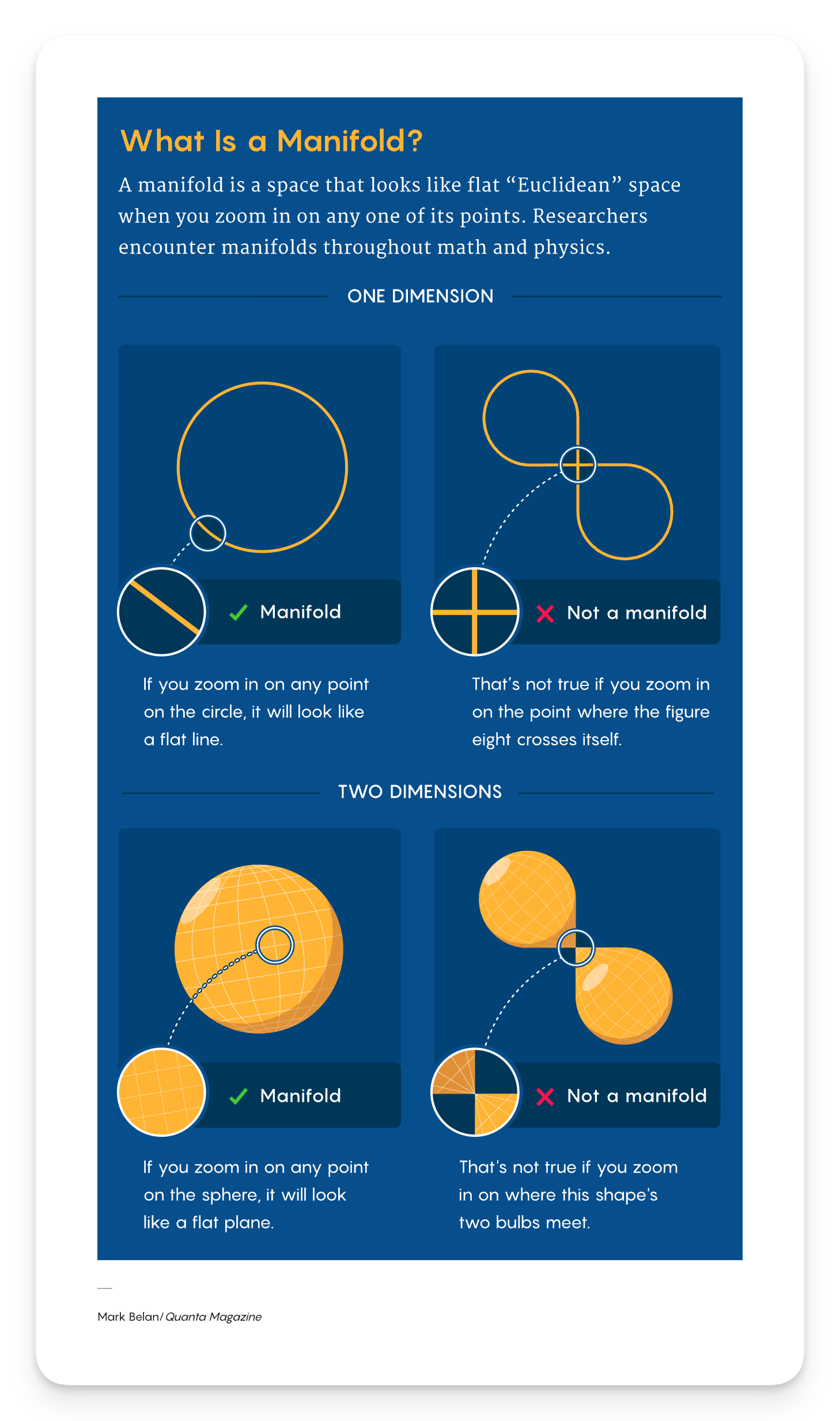
What Is a Manifold?
Standing in the middle of a field, we can easily forget that we live on a round planet. We’re so small in comparison to the Earth that from our point of view, it looks flat.
The world is full of such shapes — ones that look flat to an ant living on them, even though they might have a more complicated global structure. Mathematicians call these shapes manifolds. Introduced by Bernhard Riemann in the mid-19th century, manifolds transformed how mathematicians think about space. It was no longer just a physical setting for other mathematical objects, but rather an abstract, well-defined object worth studying in its own right.
This new perspective allowed mathematicians to rigorously explore higher-dimensional spaces — leading to the birth of modern topology, a field dedicated to the study of mathematical spaces like manifolds. Manifolds have also come to occupy a central role in fields such as geometry, dynamical systems, data analysis and physics.
There Is Wine Made in Antarctica
When you think of wine, places such as Bordeaux, Tuscany, and Napa Valley tend to come to mind first. One place you probably don’t think of is Antarctica, and yet vino is indeed made on the world’s coldest, windiest continent.
Fittingly, it’s an ice wine, a dessert wine made from grapes that freeze naturally while still on the vine, and it’s made by just one person: James Pope, whose McMurdo Dry Valleys vineyard is located on the side of the continent near New Zealand. The high saline content of the “soil” (which is closer in texture to sand) gives the wine a unique salty flavor.
I Tried Lab-Grown Chocolate. Could It Be the Future of Halloween?
Slightly waxy and distinctly bitter, it boasts those bright, fruity dark chocolate notes. I’m no expert, but I enjoyed it – and found it basically indistinguishable from regular dark chocolate.
Globally, humans consume more than 7m metric tons of chocolate per year, and our appetite is only growing. In the US, chocolate demand surges in October in advance of Halloween; the National Retail Federation estimated a $3.9bn US spend on Halloween candy this year, with chocolate options like Reese’s Peanut Butter Cups and M&Ms dominating.
But the chocolate market has grown volatile in recent years. Cacao trees – which provide chocolate’s essential ingredient – are particularly vulnerable to drought and disease. Additionally, unpredictable weather related to the climate crisis has caused production shortfalls and inconsistent harvests in key chocolate-producing regions in west Africa.
Injectable Chips Self-Implant to Treat Brain Disease Safely
What if brain surgery could be replaced by a simple injection in the arm? MIT researchers may have found a way to make that possible.
They’ve created microscopic, wireless bioelectronic devices that can be injected into the bloodstream, travel through it, and self-implant in specific regions of the brain without any need for a scalpel.
Once in place, these “circulatronics” can be wirelessly powered to electrically stimulate neurons, potentially treating diseases such as Alzheimer’s, multiple sclerosis, or even brain cancer.
The UAE Is Winning the Race to Sequence an Entire Country’s DNA
The UAE government started the Emirati Genome Programme six years ago, with the goal of mapping the genetic code of all the nation’s citizens, about a million people. As custodian for the project, it selected G42, a state-backed artificial intelligence conglomerate that owns a range of companies making cloud-computing services, cybersecurity apps and spacecraft. This includes M42, a subsidiary in charge of the genome program. (The names of many G42 companies include the number 42, an homage to The Hitchhiker’s Guide to the Galaxy, the Douglas Adams novel in which that number is the answer to the “ultimate question of life, the universe, and everything.”)
For the UAE, gene sequencing is both a public-health project and a key plank of the country’s multitrillion-dollar effort to refashion itself from a petrostate into an AI powerhouse. That project also includes plans to build massive data centers and give all Emirati residents free access to the premium version of ChatGPT.