

A weekly collection of links to interesting things curated by Colin Wright.
The Slow Death of the Power User
There’s a certain kind of person who’s becoming extinct. You’ve probably met one. Maybe you are one. Someone who actually understood the tools they used. Someone who could sit down at an unfamiliar system, poke at it for twenty minutes, and have a working mental model of what it was doing and why. Someone who read error messages instead of dismissing them. Someone who, when something broke, treated it as a puzzle rather than a betrayal.
That person is dying off. And nobody in the industry seems to care. In fact, most of them are actively celebrating the funeral while billing it as progress.
A Journey Through Infertility
I never thought becoming a mom was going to be an issue for me. I came from a fertile group of women: my paternal grandmother had 13 children, and my mother’s mom had 6.
But alas, I was not able to become pregnant after months of trying, and my doctor sent me on the route of IVF.

Online Ad Fraud Is a Feature, Not a Bug
Technological advancements and the dynamics of the platform economy make rooting out fraud more complicated than it may seem. With print media circulation and broadcast television viewership in free fall, a lot is riding on the online advertising space being able to take up the slack. The good news is, digital ad spend is booming: The global total for 2025 is expected to surpass $678 billion, at an annual growth rate of nearly 8%.
Reality TV Confronts a Harsh TV Reality
MTV announced this month that “Jersey Shore Family Vacation,” a revival of the booze-soaked early-2010s reality series, was ending after its ninth season. A few months earlier, the network said it was ending another long-running reality series, “Catfish: The TV Show,” after nearly 300 episodes.
HGTV has been on a cancellation spree as well (“Christina on the Coast” and “Bargain Block” among them), as have the Food Network, TLC and many other cable networks.
All TV shows have an expiration date, of course. But these days, reality TV is running into the harsh realities of the fast-changing TV business.
Scientists Tried to Clone Clones Forever. It Didn’t End Well
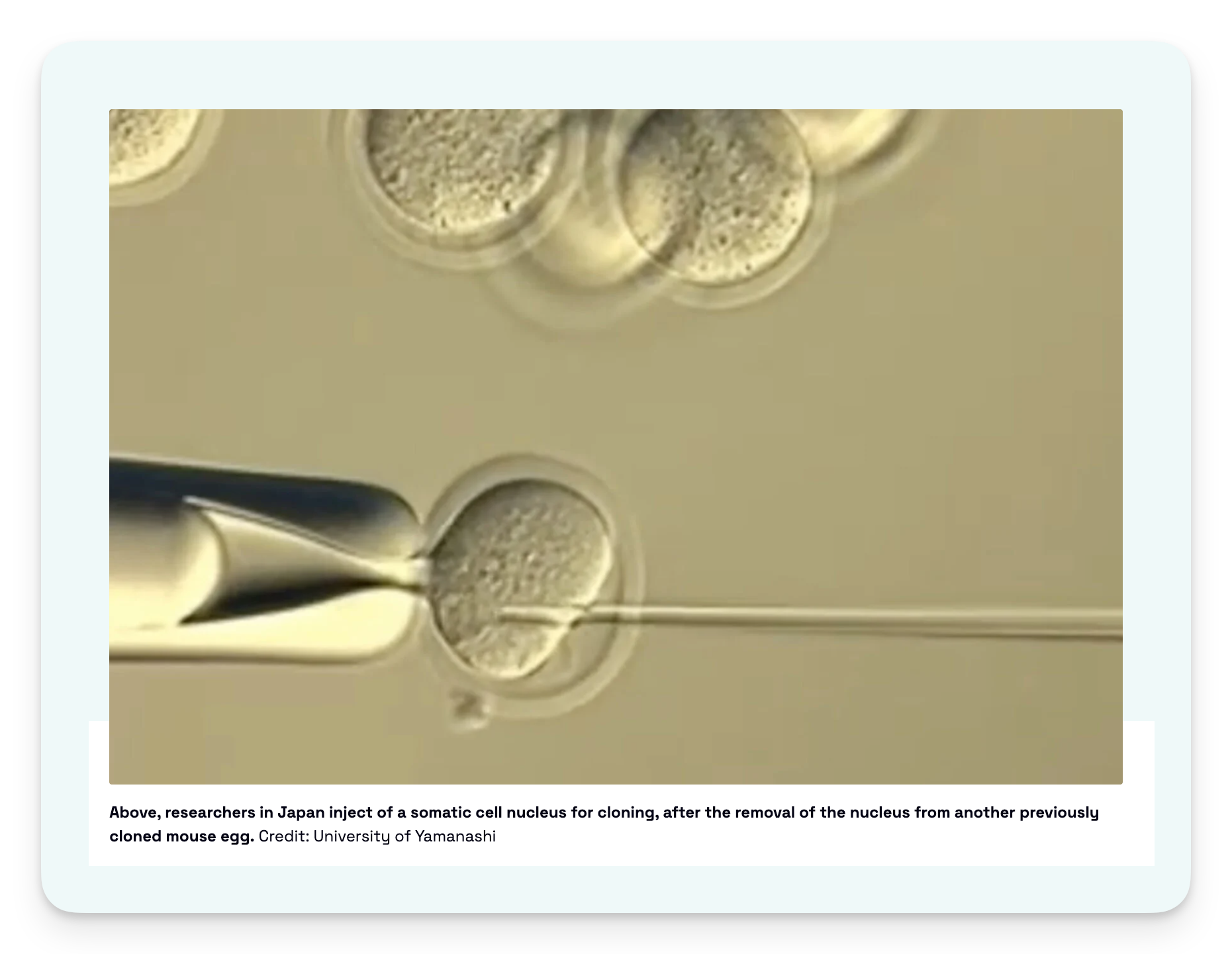
Countless scientists and at least a dozen high-concept sci-fi comedies over the past 30 years have speculated on the potentially degrading effect of making clones out of other clones, ad infinitum. The same year that researchers first cloned Dolly the sheep, the Michael Keaton comedy Multiplicity (1996) compared it to the visual static added when your office Xerox machine makes a copy of a copy of a copy.
Now, biologists in Japan have determined what they believe might actually be a hard limit on just how many successful, viable clones can be made from generations of past clones. Drawing on 20 years of their own research serially cloning mice, the team had hoped to make infinite clones of clones with the help of a promising reagent additive, trichostatin A, which helps to suppress the activity of genetic mutations during the cloning process.
“We initially concluded that serial cloning could be continued indefinitely,” Teruhiko Wakayama and his colleagues noted in their new study, published Tuesday in the journal Nature Communications, “since the success rate improved slightly with each successive generation.”
It was all smooth sailing, in fact, until the researchers started cloning their 25th through 27th generations of mice. But by the 58th generation, according to Wakayama’s team, the mice did not even survive for more than a day.
What Happens to Obsolete Oil Rigs in a Green Future? This Study Has a Smart Answer.
Recycling steel and copper from fossil fuel infrastructure to build wind turbines, solar panels, and the like could save as much as 1.95 billion metric tons of carbon emissions and US$11.69 trillion in costs to society, according to a new study.
A thorny paradox of the green transition is that building renewable energy infrastructure requires a lot of materials like steel that have large carbon and environmental footprints. The neat realization underlying the new analysis is that there’s a lot of steel and other materials tied up in fossil fuel infrastructure – which will no longer be needed in a renewable energy world.
“A significant amount of the materials that will be needed for the energy transition could be taken from decommissioned oil, gas, and coal infrastructure,” says study team member Hauke Schlesier, a graduate student at the Swiss Federal Laboratories for Materials Science & Technology (EMPA). “This can not only reduce environmental damage but also saves costs for society.”