

A weekly collection of links to interesting things curated by Colin Wright.
The Science of How Fireflies Stay in Sync
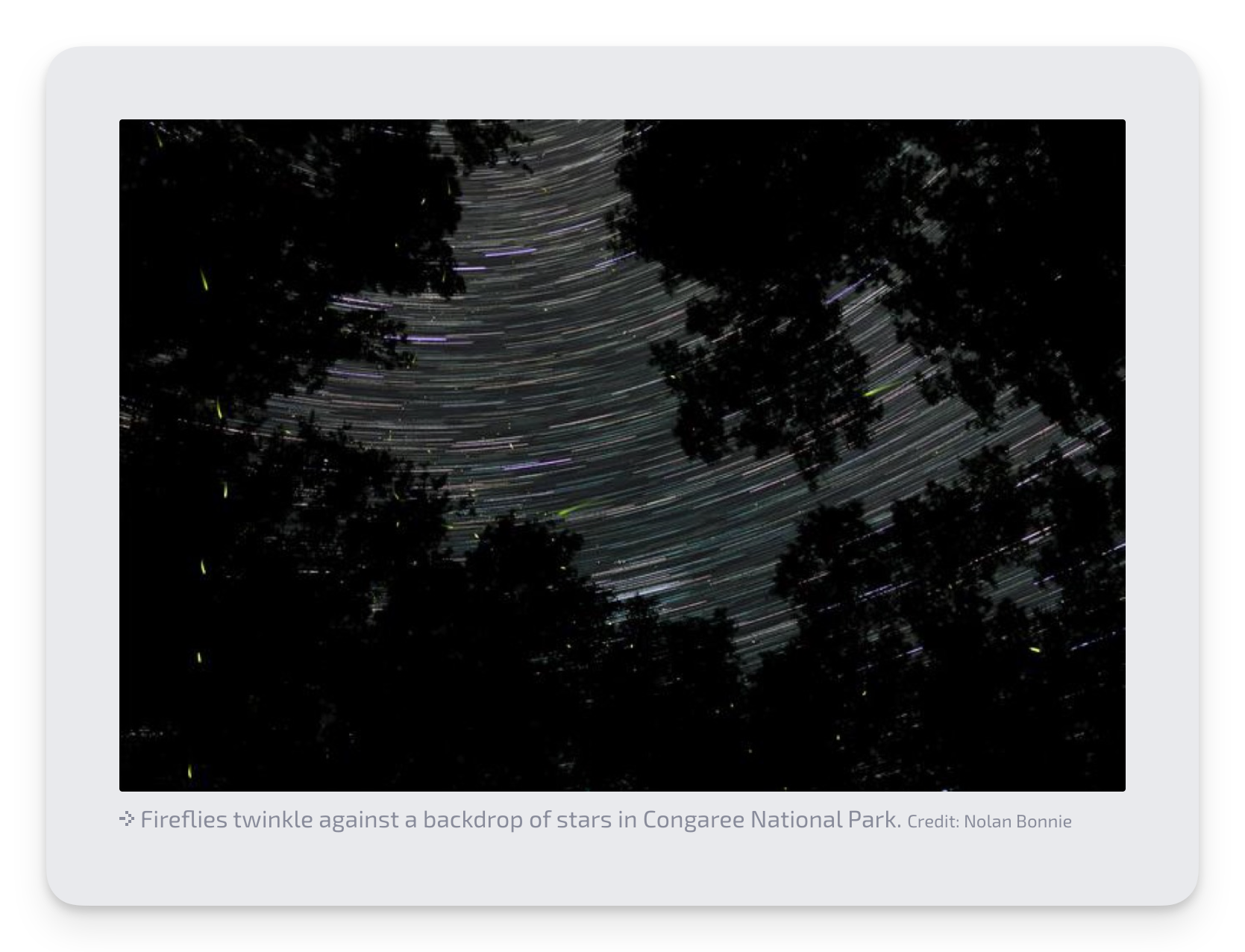
Scientists have discovered that male fireflies in a South Carolina swamp follow local interaction rules to synchronize their flashing mating displays. The research is being presented at a meeting of the American Physical Society in Denver. (A preprint is also available on the biorxiv.) Such work could one day lead to insights into how the body’s cells sync to its internal circadian rhythm, or how neurons fire together in the brain, as well as the design of drone swarms communicating through synchronized flashes.
As previously reported, research into swarming and flocking was largely relegated to observational biologists for decades. But in the 1980s, a computer graphics specialist named Craig Reynolds developed the so-called “boids” program, an agent-based computational model that has dominated collective behavior studies ever since. In such a model, each individual unit in a swarm is a dot moving in a straight line at a constant speed. By introducing a few simple rules regarding interactions between dots, a flocking pattern will emerge once the dots get dense enough. Another set of rules will produce a swarming pattern, and so forth.
50 Ideas for Life I Repeatedly Share
Your thoughts and mood are heavily impaired by things like how loud it is, how much you slept, whether you have eaten enough, if you have exercised recently, if you are stressed, etc. Always try to be cognizant of how you would think or feel about something as if you weren’t tired/angry/hungry, etc.
Most things you feel, you will feel and think about very differently in 1 hour, 1 day, 1 week, 1 month, 1 year, 10 years, etc., in the future. When thinking through any feeling or problem, consider how the future you at different time intervals would think about the same situation.
Amazon Rolls Out 1-Hour, 3-Hour Delivery as Ultrafast Shipping Trend Grows in the US
Amazon said Tuesday it’s starting one-hour and three-hour deliveries in parts of the U.S., as the company continues to look for ways to satisfy impatient consumers.
The company said three-hour delivery is available in about 2,000 cities and towns in the U.S., while one-hour delivery is available in hundreds of those areas.
“Our customers are busier than ever and are looking for new ways to save time while keeping their households running,” Udit Madan, Amazon’s senior vice president of worldwide operations, said in a statement.
The Postal Service May Be Out of Cash in 2027 Without Congress’ Help, Postmaster Says
If it continues business as usual, the U.S. Postal Service is on track to run out of cash for paying its workers and vendors in about a year and may have to stop deliveries, Postmaster General David Steiner told lawmakers this week.
The warning is the latest development in longstanding money troubles at USPS — a unique federal government agency that relies on stamps and service fees, not tax dollars, to deliver mail and packages six days a week to every address in the country.
Scientists Revive Activity in Frozen Mouse Brains for the First Time
A familiar trope in science fiction is the cryopreserved time traveller, their body deep-frozen in suspended animation, then thawed and reawakened in another decade or century with all of their mental and physical capabilities intact.
Researchers attempting the cryogenic freezing and thawing of brain tissue from humans and other animals — mostly young vertebrates — have already shown that neuronal tissue can survive freezing on a cellular level and, after thawing, a functional one to some extent. But it has not been possible to fully restore the processes necessary for proper brain functioning — neuronal firing, cell metabolism and brain plasticity.
A team in Germany has now demonstrated a method for cryopreserving and thawing mouse brains that leaves some of this functionality intact. The study, published on 3 March in Proceedings of the National Academy of Sciences, details the authors’ use of a method called vitrification, which preserves tissue in a glass-like state, along with a thawing process that preserves living tissue.
Teens Are Using AI-Fueled ‘Slander Pages’ to Mock Their Teachers
The “slander page” posts use slang terms that originate from unsavory parts of the internet. “Looksmaxxing” lingo, which comes from manosphere forums that teach men how to be more attractive, is commonly used in these memes, including words like “mog,” which means to dominate another man with one’s looks, and “sub5,” which was coined to refer to people who are subhumanly ugly.
Some “slander” videos use the AI image-to-video tool Viggle AI, which gives creators the ability to insert any photographed person into any reference video, as well as animate a static image into a lip-sync video format. Viggle AI was described as “a new frontier in the creation of spontaneous extremist propaganda” by the Global Network on Extremism and Technology, an academic research arm of King’s College London, in a recent blog post. The platform boasts over 40 million users as of February. Viggle AI did not respond to a request for comment.